
5324
IoT in Smart Buildings: Benefits & Applications
9 min read
BiztechCS can term the last decade as a decade of technological innovation. We’ve witnessed some radical changes in our lifestyles, really fast.
The telephone was replaced by mobile phones and mobile phones finally transitioned to smartphones. And, hence started the journey of “smart” devices.
These days, we see innovation in most of our everyday normal things. Smarter computers, smart cars and smartwatches are a few examples. So, if we were to follow this trend the biggest question goes: What’s next? What will we focus on making smart now? Is this the end of the smart era or there’s more to this?
Buildings have long been at the end of innovation. It’s often the last place that you’d look when you think of innovative advanced technologies. But turns out that in the smart era, even buildings are getting a transition as smart buildings thanks to technology IoT.
IoT smart buildings are becoming prevalent day by day. In some cases, they have successfully replaced conventional building management systems. Nowadays, smart building solutions enabled with IoT, influence building owners to remodel their business strategies. Stabilization and optimization are the two main reasons for developing these IoT smart buildings.
In this article, we are going to take a dive into the specifics of smart building IoT solutions. Let’s start with understanding IoT in terms of building management.

In terms of building management, IoT has a variety of applications using connected devices and data-driven decision support systems. Perhaps one of the most amazing things about IoT is that it provides predictive or pre-emptive knowledge of building/facility operating parameters even from outside the target zone.
Some of the popular examples include maintaining space temperatures, energy consumption rates, etc. The analytical advancement of IoT helps us understand what’s happening in the building and make appropriate corrections, or take pre-emptive steps to resolve problems before they emerge. Let’s see how it works.
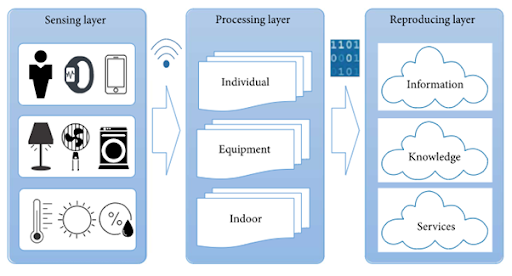
The first layer does the data collection from sensors. The data comprises
(a) individual users’ demands for operation states of appliances
(b) indoor conditions such as temperature, humidity, etc.
Later a dedicated big data cloud stores this data via a network gateway.
Next is the data processing layer. This layer classifies the collected data and then processes it. Comfort-related problems such as the HVAC system, lighting system, and temperature system require data from individual users.
The third layer is where processed data is reproduced as information concerning individual interaction between occupants and appliances. Finally, the accumulated data informs system efficacy and efficiency enhancements. Hence, it helps in providing better services for the occupants.
So, this was a mere basic idea of how the mechanism of IoT generally works. Let us now have a look at what IoT smart buildings can accomplish, their use cases, and the potential problems that they solve.
Learn how to boost a property’s operational efficiency using smart building IoT solutions.
This means you need to reimagine and redesign the same building space to prioritize indoor health and efficient operations and that too with low occupancy.
Is this possible?
Yes, with automation.
A large number of commercial and private buildings are incorporating the concept of smart buildings in their design and operations. IoT smart buildings are a lot more convenient for property managers as well as occupants. IoT Smart buildings bring multiple benefits including security, flexibility, and easy management through automation.
Let us go through these benefits and applications of smart building IoT solutions.
If yes then you will know how uncomfortable it is.
A lot of buildings these days are still uncomfortable for their property-holders. Plenty of surveys and studies notice that most buildings do not meet the occupant’s comfort.
As we saw earlier in the three-layered architecture, the individual interaction between occupant and appliance is stored, and this accumulated data helps to drive higher services for the occupants.
For example, unrepaired equipment leads to health and safety concerns. Especially for essential facilities like hospitals.
Some studies even recommend that reactionary or corrective maintenance overwhelms so many maintenance people that it takes up to 98% of their time, exploiting solely a small fraction for doing preventative maintenance.
IoT smart buildings will help make maintenance an easy job.
But many buildings do not have this advantage. Finding problems using an existing automation system is a tough task. It not only requires a skill set but takes a long-time commitment from building operators.
By implementing this automation system infrastructure, most building operators can save time without staring at the computer screen all day along with improving efficiency.
This vast amount of operative data is helpful to perpetually monitor the ongoing operational problems. Hence, building operators can free themselves from the focus of first finding the problems and then fixing them.
The location of the Building Management System (BMS) doesn’t matter. It doesn’t matter whether it is centrally situated within the structure or off-site at a secure location. The threats of IoT bring fear and concern to building owners to do something about cybersecurity.
Most building managers do not upgrade the automation systems until the point that a significant update is necessary. In a survey by Intel of around 500 building managers to determine which BMS components posed the greatest cybersecurity risks. The five biggest concerns the managers mentioned are:
Part of a solution to this problem could be virtualization of the data, i.e. using a secure cloud to store the data. Most building managers use local computers and servers. This computer has the entire automation data, and graphics, and runs the whole operation in the building. Hence making it vulnerable to cyber threats. Storing the data in a secure cloud can minimize this threat. The internal firewalls will ensure cloud security.
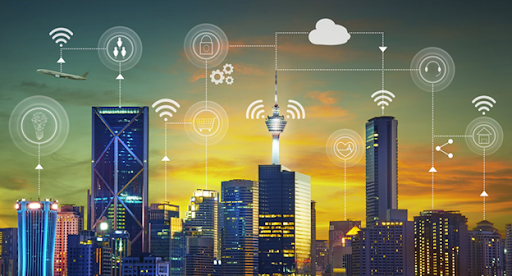
Nations around the world are developing smart cities to improve efficiency, reduce maintenance, reduce operating costs, and bring ease to the lives of residents.
It is important for building managers to keep in mind while implementing a solution that smart buildings present a set of distinctive challenges. Hence, long-range and low-power capabilities have become essential. They ensure the working of sensors, optimizing utility usage, and improving safety.
We are a reliable IoT web development firm that understands future needs and acknowledges how to secure a BMS like a fortress. We specialize in mobile app development for both platforms: Android as well as iOS and cross-platform apps. For any query or assistance, contact us here.
All product and company names are trademarks™, registered® or copyright© trademarks of their respective holders. Use of them does not imply any affiliation with or endorsement by them.
Development
Internet of Things
3150

By Devik Gondaliya

Internet of Things
8281
By yesha_bhatt
Internet of Things
2037
By Devik Gondaliya
You are at the right place.
Projects Completed
Technical Experts
Happy Clients
Years of Experience
Book a free consultation call with us





By submitting this form, you agree to our Terms of Use and Privacy Policy. All information provided will be kept strictly confidential.