2037
How Does an IoT Mobile App Optimize Water Use for Consumers?
10 min read
2037
10 min read
This issue would be resolved on an entirely different level using a mobile app based on the Internet of Things, which can provide real-time monitoring of water and improved control of consumption behavior.
The IoT-enabled water management system would provide users with remote access to monitor and modify their water consumption on their mobile devices for better resource management.
With the growing interest in smart solutions, many organizations are turning to IoT mobile app development services to build intelligent systems that address these modern challenges. The app utilizes IoT cloud infrastructure for data collection and analysis, providing significant insights for both commercial and residential installations.
The technology will enable prevention, allowing it to identify a leak and notify the user before it becomes a critical issue.
In short, the IoT mobile app facilitates customers with tools that optimize their water utilization towards achieving sustainability objectives.
Timely possession of real-time data can be a lifeline for water management, particularly in industries that rely on precision to minimize costs and optimize resource utilization.
This makes data unreliable and hampers decisions under water conservation strategies. Inconsistency in data further diminishes any remaining chances of effectively optimizing water use and may even skew accurate conclusions about water consumption behavior.
Inefficiencies lead to excessive repairs and maintenance, resulting in downtime that incurs losses. Furthermore, high operational costs are a deterrent to investing in more advanced automated solutions that can improve efficiency.
It also prevents the quick detection of issues that can be corrected to save water. The inadequacy of real water management results in inefficiencies and lost opportunities for conservation.
Such delayed detection results in significant water loss over extended periods, leading to increased resource wastage and higher costs. Automated continuous monitoring in real-time is necessary to detect and immediately correct such occurrences before they worsen.
With this app, both enterprises and consumers can quickly adjust their water settings, hence optimizing their water use and minimizing wastage. This app also allows remote configuration and management of smart water devices. It collects and analyzes transactional data, providing users with necessary insights into water patterns to make informed decisions.
Users can also set alerts for suspicious water consumption or concerns, allowing them to manage their water usage proactively. This mobile app, therefore, promotes sustainable behavior and encourages immediate user action as needed to enhance water use control.
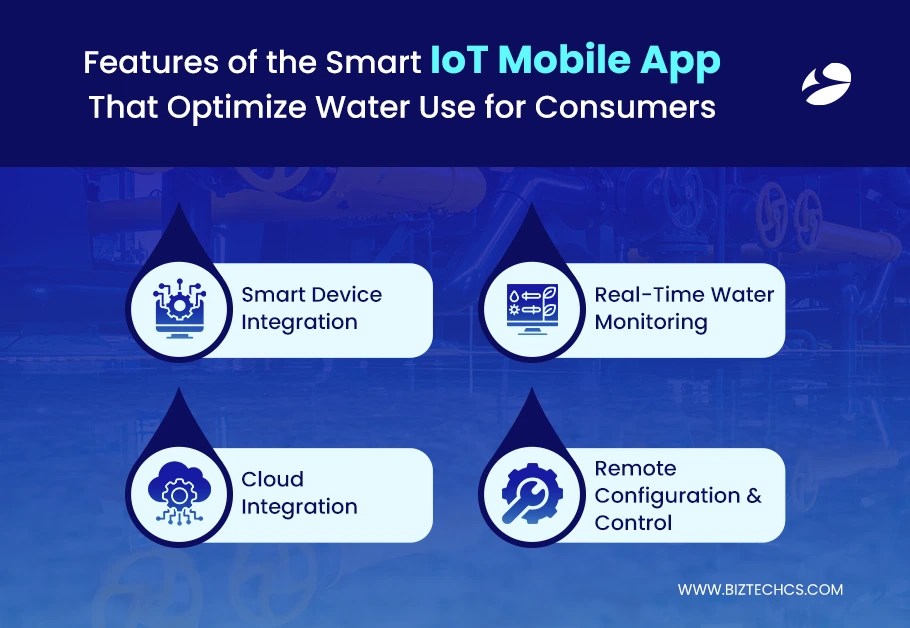
Users can easily manage their devices; these include setting the devices to balance their consumption with the quality of the output. The app makes it quite efficient and straightforward to manage multiple home devices, thereby ensuring that the water-saving potential is maximized.
With such prompts at hand, users will be better equipped to react when necessary. Up-to-date reporting would also be available on inefficiencies, leaks, and informed decision-making.
Thus, this ensures the application is always in real-time and reactive, allowing for the avoidance of all possible waste.
As such, this will centralize the data, making it current and available on multiple devices. It also enables trend analysis for making future strategic decision-making and saving water for the long term, thus allowing long-term storage for cloud data.
Users can set timers, manage consumption limits, and activate water-saving modes, all remotely. Using remote controls, it defines the flexibility of usage and ensures at all times the optimal use of water.
With IoT cloud infrastructure, data flows quickly from sensors to decision-makers. IoT water management is not just about saving water; it’s about using it right. When each drop counts, insight matters more than guesswork.
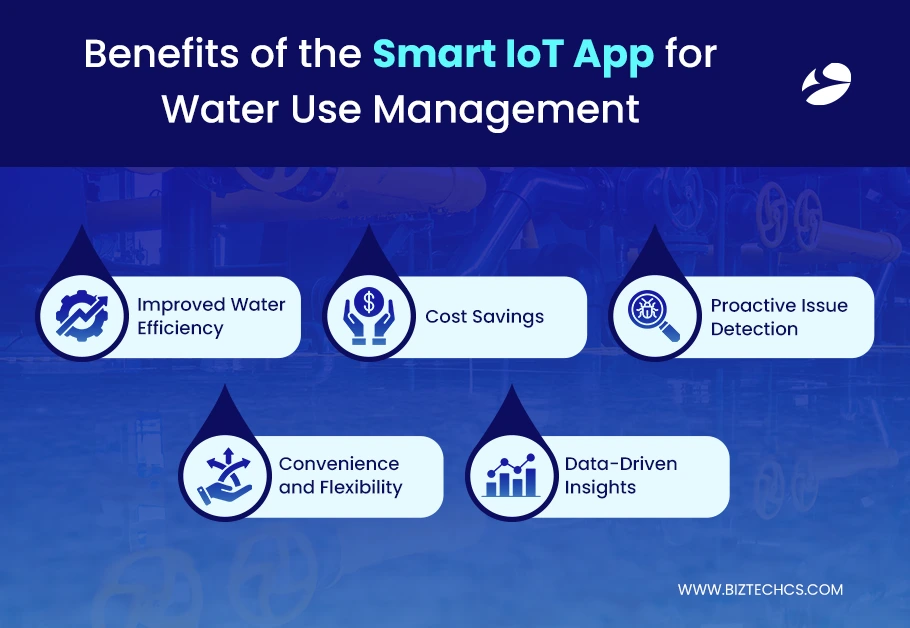
Thus, a more sustainable way of managing water, with proper advantages for both the environment and the overall cost of its users, will be effective.
The application continuously monitors water consumption and alerts users if an unusual event occurs. This preventive approach enables one to implement quick steps that significantly reduce the overall water bill.
In all cases, the issue can be resolved at an early stage before expenses increase as a result of the problem.
Early detection thus saves time, money, and other resources by preventing more significant problems that would have resulted.
It is thus made available to the user at their fingertips at all times, enabling efficient water management.
This data-driven approach will prove beneficial in effluent and sustainable water management over time.
These insights would enhance commercial and consumer decision-making, enabling the maximization of materials usage and waste minimization, ultimately improving the overall water management picture.
Thus, it will be possible for water management systems to take timely and proactive action regarding issues, thereby preventing problems and increasing operational efficiency.
With all data collected and made available in one central location, end-users will be able to monitor and control their water consumption in real-time anywhere.
Apart from having central data with easy updates for maintenance and efficiency, such an integration improves the reliability of the water management systems.
With real-time monitoring and predictive analytics technologies, it will be possible to ensure the use of water only when and how much is needed, thereby conserving it.
While contributing to environmental preservation, these initiatives may promote sustainable practices in water usage across industries and communities.
Improving water management could have a significant impact on addressing global water scarcity in the near term and promoting long-term sustainability.
The IoT-based water management system allows a user to remotely operate and set water controls in a way that saves time and money.
Cloud integration also renders it possible to always keep the data fresh and accessible such that a user can view usage patterns and trends. Leaks and inefficiencies can be picked up at an early stage, thus saving significantly on costs and supporting sustainability.
While the IoT water management paradigm turns, further predictive technologies such as AI will consequently assist in nurturing conservation.
In other words, while it assists in immediate water optimization, the technology also ensures continuous improvement through the real-time control and monitoring of water, thereby enhancing the ultimate goal of sustainable conservation.
You are at the right place.
Projects Completed
Technical Experts
Happy Clients
Years of Experience
Book a free consultation call with us




By submitting this form, you agree to our Terms of Use and Privacy Policy. All information provided will be kept strictly confidential.