2592
Why the Healthcare Industry Needs Odoo ERP to Solve Real-World Operational Challenges?
5 min read
2592
5 min read
Scheduling is done manually, frequently leading to double bookings or missed appointments. Billing errors trigger red flags only when revenue reports are reviewed. Compliance teams scramble to meet reporting deadlines.
Meanwhile, patients expect a seamless, digital-first experience throughout the entire process. Under high operational pressure, existing systems become cumbersome and ineffective for patchwork solutions.
With the help of Odoo ERP development, Odoo ERP for healthcare connects every part of the organization through a unified, modular platform. From appointment management to pharmacy inventory, lab coordination to financial tracking—everything flows through one system. This results in fewer errors, streamlined processes, and improved outcomes for both staff and patients. In a multispecialty hospital, the implementation of the system led to a 22% increase in daily operational efficiency within 90 days (source).
A well-implemented healthcare ERP system is not just an upgrade; it is a strategic lever for sustainable, data-driven care.
When it is time for NABH, NABL, or insurance auditing, the search for papers sets the team into a feverish, last-minute chaos. These are significant problems that indicate manual mechanisms are no longer sufficient. When coordination breaks down, the quality of service and revenue suffer as well.
That is when a healthcare ERP system becomes essential: it brings structure, control, and visibility to every process. By addressing these problems at their root, healthcare facilities can enhance care delivery, prevent costly delays, and maintain audit readiness at all times. Waiting until chaos erupts means risking patient trust and operational stability.
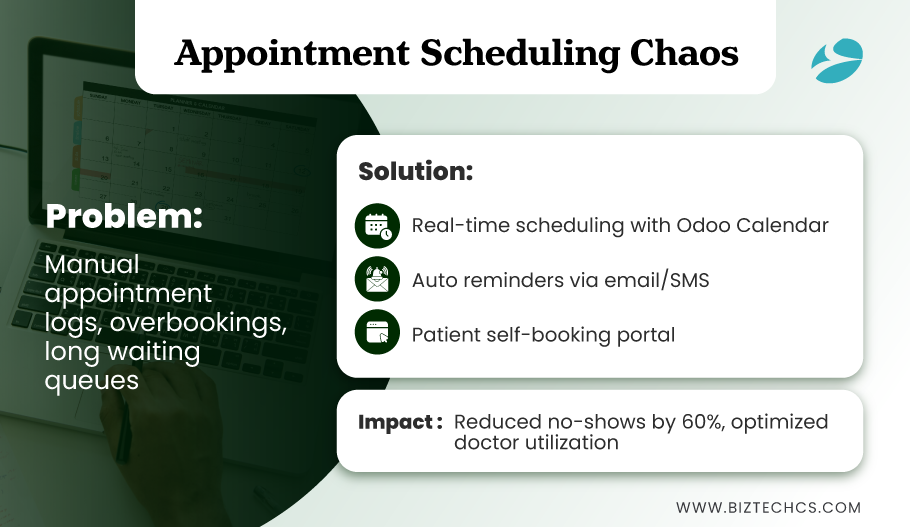 The scheduling and appointment process became manual, leading to overbookings and long queues. Patients wait while the receptionist juggles availability confirmations, creating a very frustrating experience for all stakeholders.
By utilizing the hospital management ERP system in Odoo, appointments can be scheduled in real-time, and doctors’ calendars are synchronized across departments.
Patients receive automatic SMS and email reminders about their appointments. This reduces the need for front-desk booking. As a result, no‑shows decrease and doctor availability increases.
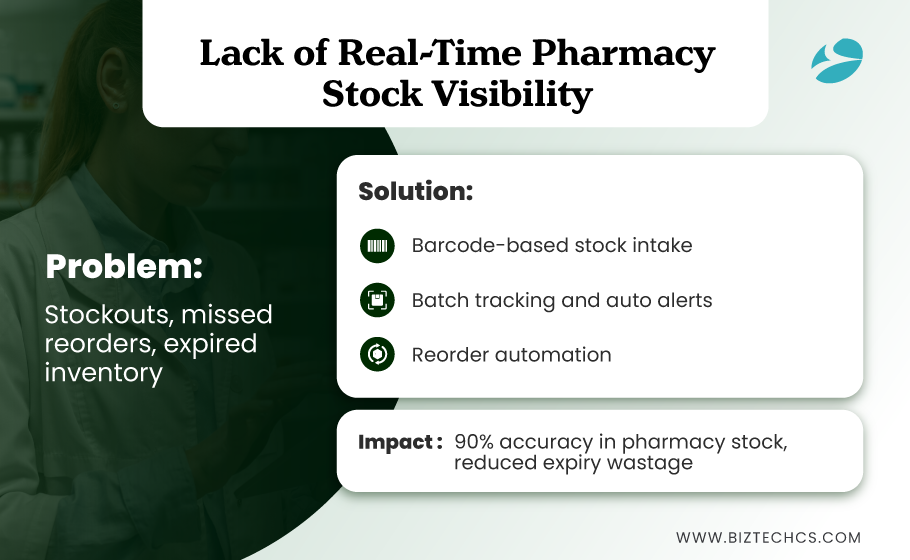 Manufacturing expired medicine, stockouts, and missed reorders cause significant problems at a pharmacy lacking digital control. These issues hamper the continuity of treatment and reduce patient confidence.
To address this, an experienced Odoo development company provided clear visibility into stock levels, barcode-based inward movement, batch tracking, expiry alerts, and more. Automatic reordering ensures that essential medicines are always available.
This healthcare ERP system enables the pharmacy to maintain 90% accuracy in its stock levels while significantly cutting losses related to expired medicines (source). Combined with reduced time spent on inventory management, it helps ensure uninterrupted care for patients.
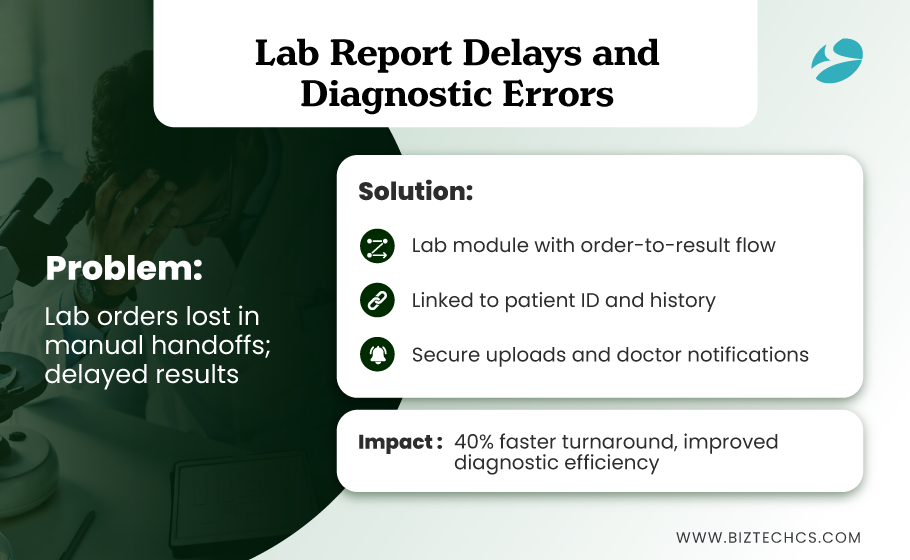 Labs often lose track of orders due to paper-based handoffs. Reports are delayed or mistakenly filed away, causing patient anxiety and diagnostic errors. odoo erp implementation company streamlines the entire lab process—from ordering tests to uploading results—into a single integrated system.
Each test is linked to the patient’s ID and medical history. Doctors are automatically notified when results are ready. Reports are securely stored and can be instantly retrieved. This automation results in a 40% reduction in turnaround time, greater accuracy, and, consequently, improved diagnostic reliability (source).
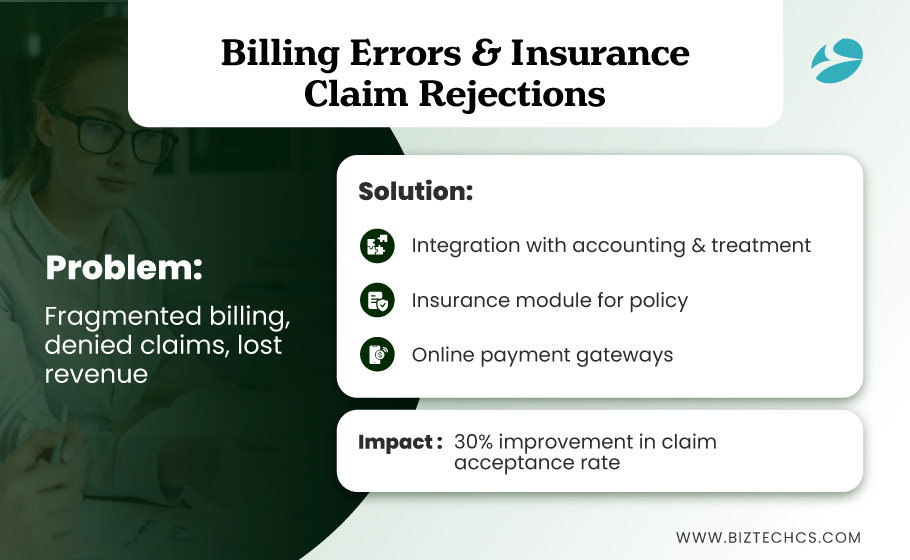 Fragmented billing systems often lead to mismatched charges and denied insurance claims. This results in revenue leakage and additional rework for the administration. By leveraging Odoo’s billing integration and odoo ERP implementation services, each treatment is accurately linked to relevant codes and insurance policies.
This ensures that payments and receipts are tracked electronically, while the insurance module aligns each claim with applicable policy terms.
As a result, the claim acceptance rate improves by 30%, and billing disputes are significantly reduced (source). This streamlined approach, supported by a hospital management ERP, ensures transparency and clarity for both finance teams and patients.
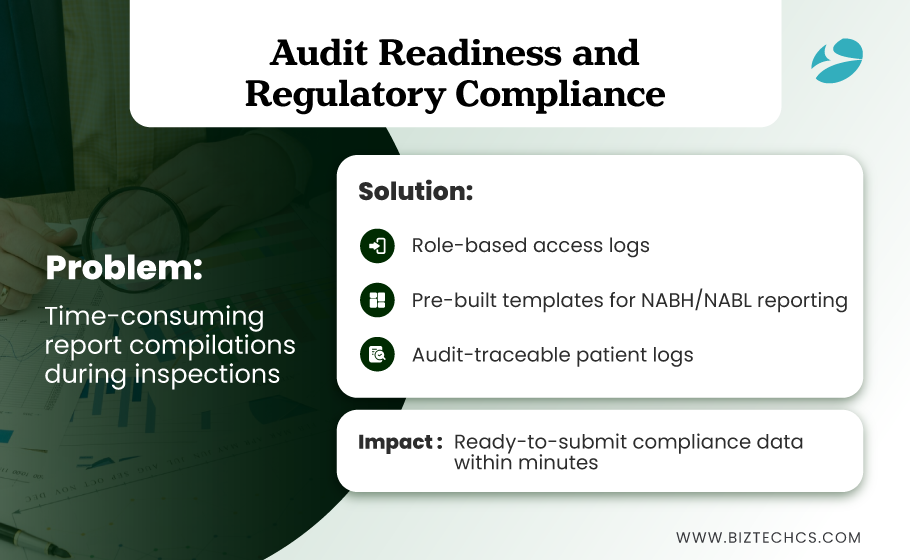 When data is scattered, preparing for NABH, NABL, or insurance audits can take weeks. Reports are often assembled manually, which means they can be either incomplete or inappropriate for their intended purpose.
Odoo ERP modules provide a comprehensive solution to the complexities of compliance, featuring specific features developed for healthcare regulations. Templates for all required reports, role-based access controls, and audit logs ensure that nothing is overlooked.
The Odoo patient management system captures every interaction with a patient, providing a well-structured framework that enables teams to access ready-to-submit data within minutes. As a result, inspections become significantly faster, smoother, and less stressful to manage.
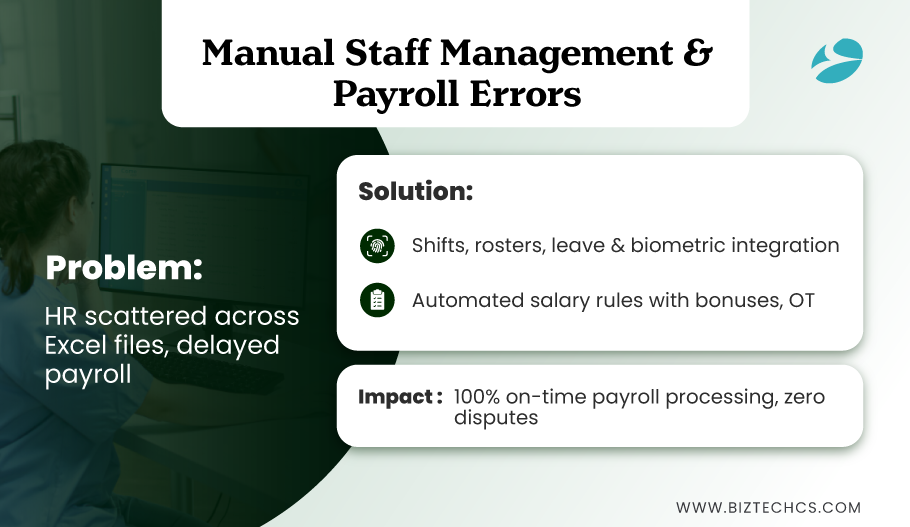 Managing HR with spreadsheets causes delays in payroll processing, miscalculations in overtime rates, and leads to employee dissatisfaction. It also becomes difficult to accurately track card-ins and card-outs, shifts, leaves, and attendance. Odoo addresses these challenges through complete HR automation.
All shifts, biometric attendances, leave tracking, and salary rule calculations are managed within a single integrated system. Bonuses and overtime payments are computed accurately and delivered on time, ensuring a smooth payroll experience. Partnering with an experienced Odoo ERP Customization company can help tailor this solution to fit your organization’s specific HR and payroll needs.
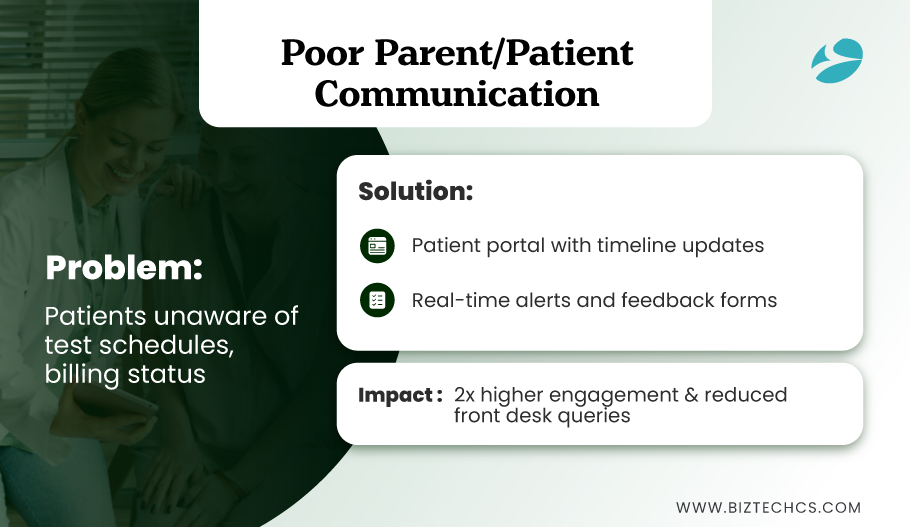 Patients often miss appointments or fail to provide billing information due to a lack of timely updates. The front desk is repeatedly asked the same questions. Odoo resolves this with a patient portal. It provides a timeline of visits, bills, reports, and updates.
Real-time reminders keep patients informed at every step. Feedback forms enable facilities to understand concerns upfront and address them. The result: patient engagement is doubled, and front desk stress is eliminated. The communication loop is streamlined and efficient.
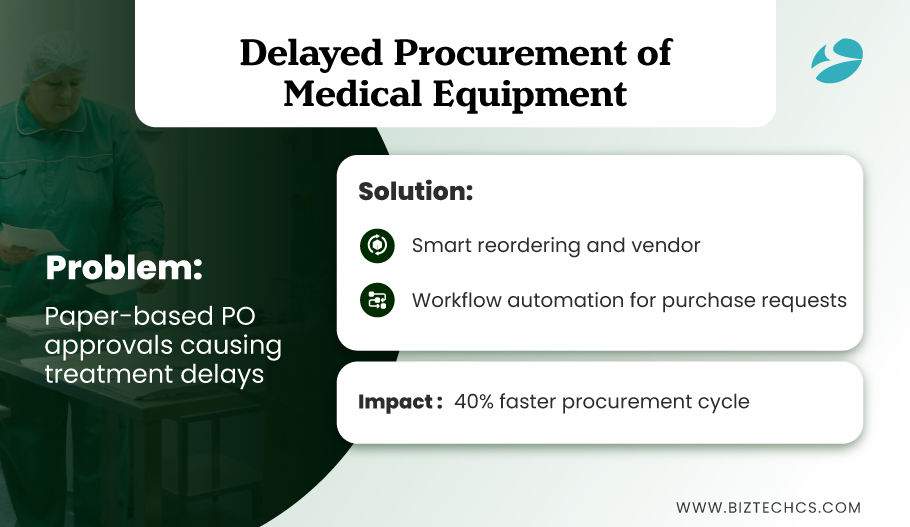 Paper or email trails for purchasing cause undue delays. Vendor confusion and approval wait times can affect life-critical treatments. Odoo Integration services streamlines procurement with intelligent workflows.
Medical supply reorders are triggered based on quantity thresholds. The system reconciles vendors by comparing prices and availability. Purchase requests are processed efficiently through electronic approvals. This ensures that doctors get what they need—when they need it—without administrative bottlenecks.
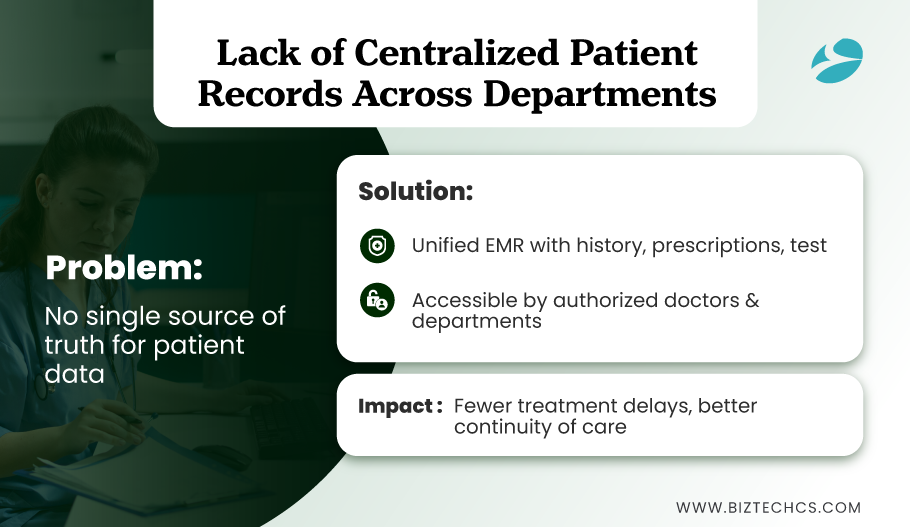 When every department uses a separate system, patient information becomes fragmented and complex to access. Physicians lack a complete picture, which slows down treatment. With Odoo ERP for healthcare, all patient records—prescriptions, history, and test reports—are consolidated in one place.
The Odoo patient management system ensures that authorized personnel have access to accurate, up-to-date information across departments. This eliminates repeated questions, missing records, and treatment delays. As a result, decision-making becomes faster, and care is more standardized throughout the patient journey.
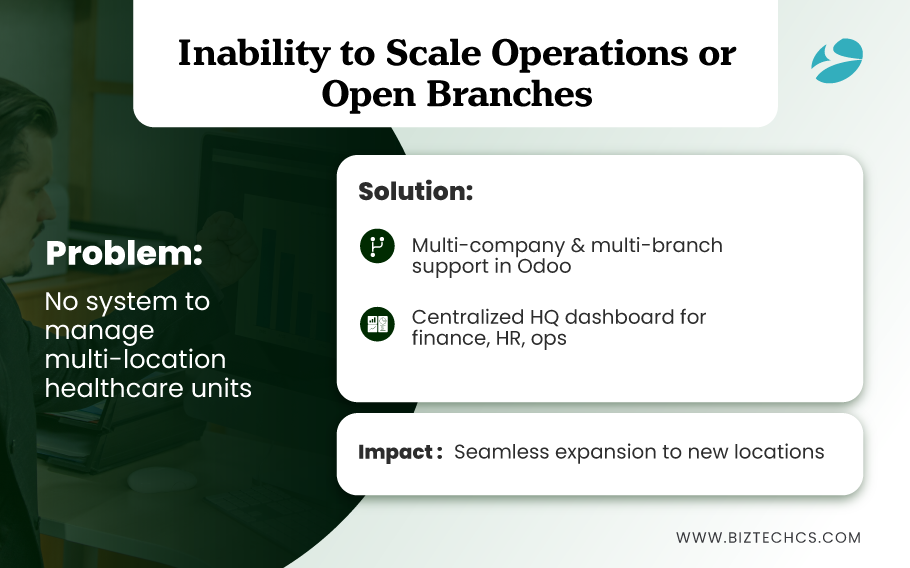 Most healthcare facilities struggle to expand, as their infrastructure cannot accommodate more than one branch. Administrative work increases, and visibility between locations is lost. Odoo addresses this through its multi-branch and multi-company functionalities. Finance, HR, and operations are controlled from a single central command center.
Additional branches can be integrated into the same system without having to start from scratch. As operations scale, control remains tight. Healthcare providers implementing this method grow seamlessly, maintaining complete control through a single digital command center.
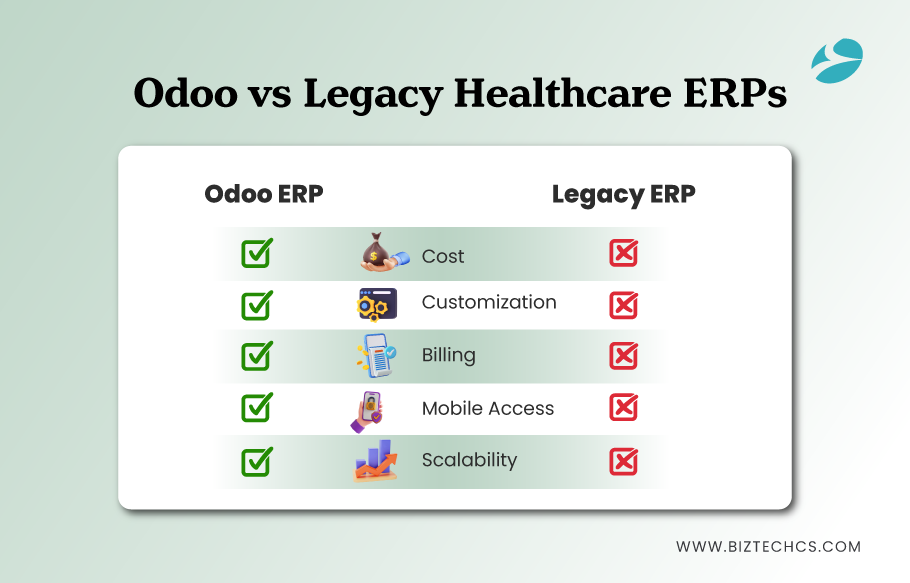
| Odoo vs Legacy Healthcare ERPs | ||
|---|---|---|
| Feature | Odoo ERP | Legacy Systems |
| Cost | Affordable, user based pricing | Expensive and rigid pricing |
| Customization | Highly customizable (Open Source) | Limited customization options |
| EMR Integration | Built-in EMR functionality | Often requires third-party integration |
| Pharmacy/Lab Support | Seamless pharmacy and lab modules | Manual or disconnected workflows |
| Insurance/Billing | Automated insurance workflows | Manual claim forms and tracking |
| Mobile & Cloud Access | Mobile-ready, full cloud support | Desktop-based or limited access |
| Multi-Branch Support | Native multi-branch support | Extra licenses for each branch |
| User Interface | Modern, user-friendly interface | Outdated, complex interface |
| Third-Party Add-ons | Vast marketplace of add-ons | Limited or costly integrations |
| Implementation Speed | Faster deployment | Lengthy and costly setup |
| Maintenance & Updates | Frequent, easy updates | Infrequent updates, high costs |
| Scalability | Scales with organization size | Challenging and costly to scale |
At BiztechCS, we specialize in implementing Odoo ERP for healthcare organizations, enabling providers to streamline operations, efficiently manage patient and resource information, and meet regulatory compliance requirements in the healthcare sector.
Appointment planning includes doctor schedules, calendar synchronization, and automated alerts. We also integrate scheduling with billing, pharmacy, and CRM modules to prevent duplication and delays.
We implement auto-replenishment based on consumption patterns and minimum stock quantities. This keeps pharmacies up to date and avoids stockouts.
Role-based permissions and encrypted data handling are ensured to safeguard sensitive patient data. Reports are pre-formatted for inspections and audits within minutes, helping healthcare staff maintain compliance without the hassle of paperwork.
We also monitor equipment usage and maintenance schedules to prevent costly breakdowns. Departmental reports provide real-time insights into revenue, expenses, and profitability, enabling leadership to stay informed and make more informed decisions.
At BiztechCS, we leverage our expertise to customize Odoo, addressing real healthcare needs—not just technical checklists. The outcome is quicker decisions, improved coordination, and more seamless audits. For growing providers, it’s not merely a system upgrade—it’s a transition to sustainable, effective care.
All product and company names are trademarks™, registered® or copyright© trademarks of their respective holders. Use of them does not imply any affiliation with or endorsement by them.
[display_faq]
You are at the right place.
Projects Completed
Technical Experts
Happy Clients
Years of Experience
Book a free consultation call with us





By submitting this form, you agree to our Terms of Use and Privacy Policy. All information provided will be kept strictly confidential.