
How Can AI Predictive Analytics Transform Your E-Commerce Data Into a Profit Machine?
5 min read
5 min read
E-commerce produces a data tsunami — consider this: every click, cart abandonment, midnight impulse buy adds to a staggering flow of information. In 2024, the global digital world generated about 147 zettabytes of data — that’s roughly 147 trillion gigabytes of shopping patterns, abandoned carts, idle scrolls, and purchase impulses (source). This data gold mine makes oil reserves look like spare change.
Each click tells a story. Each search reveals intent. Each purchase creates the blueprint for the next sale. In an age where being data-driven can define winners and losers, this tidal wave of consumer data is both the fuel and the roadmap for modern e-commerce.
The problem? Everyone’s digging in the same mine. Amazon processes 536,238 orders per hour while smaller players fight over the leftovers (Source). Competition got uglier than a clearance-sale riot. Traditional retail tactics work about as well as fax machines at a tech startup. Winners and losers get decided in milliseconds, not quarterly reports.
Smart money’s betting on AI-powered e-commerce solutions that turn chaos into cash. With advanced AI/ML development, predictive analytics starts reading customer intent without any crystal-ball nonsense. The impact is real: companies using AI in e-commerce see conversion rates quadruple — shoppers who interact with AI chatbots convert at 12.3%, compared with just 3.1% when they don’t. (Source)
They know what customers want before the customers do. Like having tomorrow’s newspaper today, except it’s legal and infinitely more profitable.
This breakdown shows how e-commerce optimization with AI transforms wishful thinking into predictable revenue. You’ll discover what separates the algorithms that print money from the ones that burn it. Real stories where data beat gut instinct bloody. The exact playbook for turning browsing patterns into buying frenzies. Consider this your masterclass in digital mind-reading.
AI-driven e-commerce systems are like a data-hungry monster that hardly ever sleeps, and they are always there to analyze customer clicks and abandoned carts as if they were the only things that mattered, discovering patterns that even your top analyst would not be able to see after taking espresso shots.
These systems learn from every transaction faster than your competition can spell “bankruptcy,” with McKinsey forecasting that agentic commerce could generate as much as US $3-5 trillion globally by 2030—while their rivals wonder what hit them (source: Digital Commerce 360).
The cloud-native architecture scales up and down like a CEO’s patience during quarterly reviews, delivering e-commerce optimization with AI that processes predictions in real-time while traditional systems are still booting up.
Your data becomes your competitive edge, turning those seemingly random customer behaviours into profit margins that would make Wall Street weep with joy.
Your business could see 73% higher sales growth with AI in e-commerce while competitors are still using Excel sheets from 2019 and praying to the inventory gods. Companies report 35% happier customers and 25% better lifetime value because e-commerce optimization with AI catches problems before customers can write those delightfully passive-aggressive reviews.
It’s basically legal insider trading, except instead of jail time, you get profit margins that make shareholders forget about that questionable Q2 decision. But here’s what C-suite executives always ask: ‘How quickly can we actually see returns from implementing predictive analytics?’
The honest answer: companies typically see initial wins within 60-90 days, with full ROI materializing in 6-12 months. Early victories come from quick wins like reducing cart abandonment by 15-20% through behavioral triggers, while the compound effect of better inventory management and personalized experiences builds that 1,300% ROI over time.
The spreadsheets breed like unsupervised teenagers, the analytics tools mock you silently, and meanwhile, your competitors who figured out e-commerce optimization with AI are eating your lunch, dinner, and tomorrow’s breakfast too.
Without AI in e-commerce to translate this digital mess into actual money-making decisions, you’re basically throwing spaghetti at the wall and praying something sticks before the quarterly report comes due.
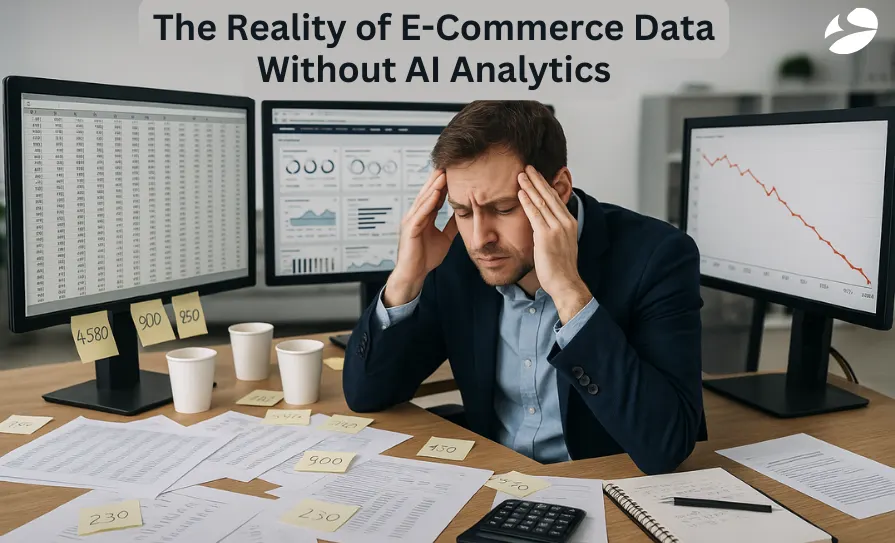
Leadership teams often wonder: ‘What if our data quality isn’t perfect—can predictive analytics still work?’ Here’s the reality check: perfect data is a unicorn nobody’s ever caught. Modern ai ml development are built to handle messy, incomplete data—they can work with 70-80% data completeness and still outperform human gut instinct by miles.
The algorithms actually get smarter at filling gaps and spotting anomalies, turning your data dumpster fire into actionable insights.
Your “personalized” recommendations make about as much sense as suggesting scuba gear to someone in the Sahara, and by the time you catch wind of the next trend, it’s already deader than your competitor’s conscience when they stole your market share.
Companies using AI-powered e-commerce solutions are serving customers champagne while you’re still figuring out why your generic emails land straight in spam. It proves that e-commerce optimization with AI isn’t just nice to have anymore—it’s the difference between thriving and becoming a cautionary tale at business school.
Are you tired of watching competitors leverage AI while your valuable customer data goes unused? There’s a smarter path forward that doesn’t require starting from scratch.
Meanwhile, before you even finish your morning coffee, the businesses that are using AI-powered e-commerce are adjusting the prices, predicting breakups of the customers before the awkward goodbye text, and spotting trends. At the same time, you are still confused as to why no one wants your fidget spinners anymore.
Your clients are dropping their digital crumbs everywhere, like where they click, browse, and leave their carts unattended (yes, we see you, the late-night shoppers who get scared at the checkout process).
BiztechCS’ AI/ML development services can seamlessly help you apply the latest behavior-analytics techniques to track and forecast how customers move across different travel touchpoints. With advanced predictive models, we can identify micro-patterns in user actions and preferences—allowing your platform to deliver hyper-personalized experiences at exactly the right moment.
The main point is to understand that the customer who buys organic dog food every month at 2 AM is definitely not going to switch to budget kibble so soon.
Business leaders inevitably ask: ‘How accurate are these predictions really?’ Real-world accuracy rates hover between 75-85% for purchase predictions and 80-90% for churn identification—not perfect, but infinitely better than the 20-30% accuracy of traditional segmentation. The kicker? Even at 75% accuracy, you’re making three correct decisions for every wrong one, while your competitors are still flipping coins.
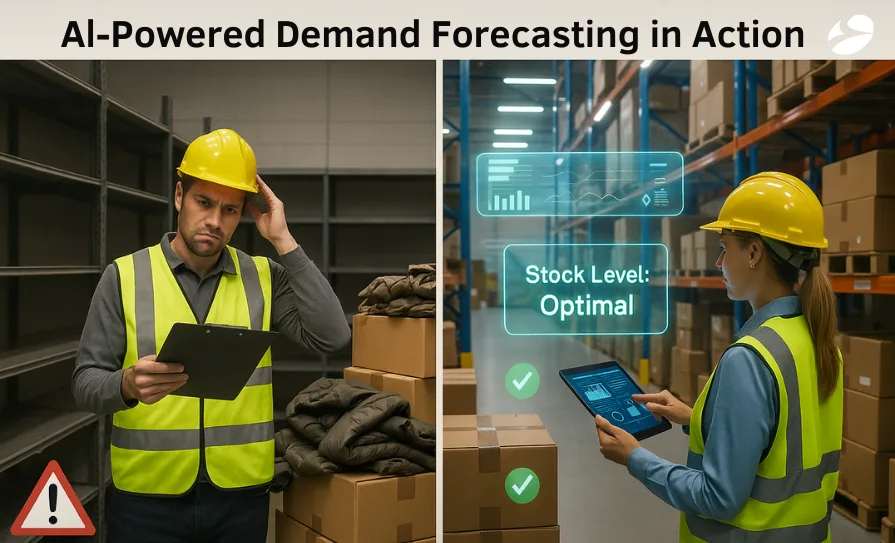
Seasonal trends aren’t just about Christmas rushes anymore; they’re about understanding why umbrella sales spike every time a weather app shows a cloud emoji. BiztechCS can build intelligent demand forecasting systems that integrate multiple data sources, including weather patterns, social media trends, and economic indicators.
We can create adaptive models that self-adjust based on real-time market conditions. Because nothing says “prepared” quite like having exactly the right inventory when TikTok decides your product is the next big thing.
The sweet spot between profit margins and customer satisfaction isn’t mythical; it’s mathematical. AI in e-commerce makes this dance between supply, demand, and sanity actually manageable. Your pricing engine becomes smarter than that one colleague who memorizes every competitor’s catalog (we all know one). Here’s what keeps executives up at night: ‘Won’t dynamic pricing start a race to the bottom with competitors?’ Actually, no—smart pricing algorithms optimize for profit margins, not just competitive matching.
They factor in demand elasticity, customer lifetime value, and inventory costs to find price points that maximize profitability while maintaining market position. It’s chess, not checkers, and the AI is playing ten moves ahead while competitors react to yesterday’s prices.
Could your pricing strategy be leaving money on the table every single day? Most e-commerce businesses discover they’ve been underpricing bestsellers and overpricing slow movers for years.
The algorithm doesn’t just push high-margin items; it calculates customer lifetime value like a chess grandmaster planning seventeen moves ahead. E-commerce optimization with AI means recommendations that actually make sense, not suggesting snow boots to someone who just bought a surfboard. Unless they’re planning a very confused vacation, in which case, carry on.
The system identifies at-risk customers faster than you can spell “unsubscribe.” Customer win-back campaigns become precision strikes rather than desperate mass emails begging for attention. Because winning back a customer costs less than finding a new one, and your accountant will thank you for remembering that basic math still applies in the digital age.
Natural language processing decodes customer reviews better than your legal team interprets contract loopholes, turning “This product is fire” into actual sentiment data rather than a safety concern. AI-powered e-commerce solutions basically give your business a PhD in pattern recognition without the student loans.
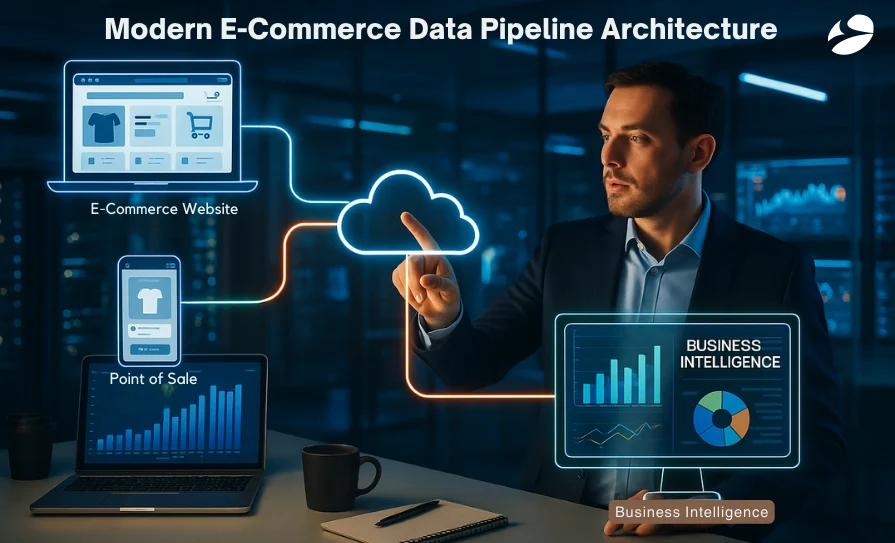
BiztechCS can build cloud-native solutions on AWS, Azure, or Google Cloud Platform. Besides, we can set up serverless architectures that automatically adjust based on user demand, thus being cost-efficient while still delivering high performance during peak times.
API integrations will ensure that your systems communicate as smoothly as a Swiss watch assembly line, because the outdated practice of using the telephone between databases is like using flip phones.
Stream processing systems handle incoming data flows like air traffic controllers during the holiday season—except they never need coffee breaks or vacation days. With the right AI/ML development services, these systems don’t just process data; they learn from it, predict patterns, and optimize responses in real time. That’s exactly why e-commerce optimization with AI depends on these pipelines running as smoothly as your sales pitch to investors.
The whole architecture works together like a well-oiled machine, if that machine could predict the future and never needed WD-40.
Data audit and quality check expose gaps wider than the Grand Canyon, except less scenic and more panic-inducing. We can help you discover that half your data is playing hide-and-seek while the other half speaks different languages.
Goal setting and KPI definition stop being wish lists written to Santa and become actual, measurable objectives. Because ‘increase sales’ isn’t a strategy; it’s what your investors mutter in their sleep.
The question every CFO asks: ‘What resources and budget are we really talking about here?’ Implementation typically requires 15-20% of your annual IT budget upfront, with ongoing maintenance and optimization costs of 5-8%.
You’ll need a team of 3-5 dedicated people for the first six months, then 1-2 for ongoing management. Compare that to the cost of losing 10% market share to AI-enabled competitors, and suddenly it looks like the bargain of the century.
BiztechCS can architect solutions that won’t collapse faster than a house of cards in a hurricane. Integration planning maps out how your shiny new AI-powered e-commerce solutions will communicate with your legacy systems without sparking a civil war.
We ensure your platforms play together nicely, unlike your sales and marketing departments at the quarterly meeting. The whole design phase determines whether you’re building a rocket ship or a costly paperweight.
We can implement AI in e-commerce that actually works, not just looks impressive in PowerPoint presentations. The testing phase separates “it works on my machine” from “it works for ten million users simultaneously”. Your new predictive analytics system needs to handle Black Friday traffic without breaking down.
Scaling strategies prepare you for growth spurts that would make teenage boys jealous, except your infrastructure actually keeps up. We develop expansion plans that accommodate success without requiring infrastructure prayers and midnight panic attacks.
E-commerce optimization with AI means your system gets smarter while your competitors still debate whether to upgrade from Windows XP. The beauty of proper scaling is watching your system handle viral TikTok moments without anyone losing sleep or sanity. Senior leadership always wants to know: ‘How long until we’re fully AI-optimized and ahead of the competition?’ The uncomfortable truth: it’s never ‘done’—predictive analytics is a continuous evolution, not a destination. But here’s the good news: you’ll be operationally ahead of 70% of competitors within 6 months, and in the top 10% within 18 months if you commit to continuous improvement.
The gap between AI adopters and traditionalists widens each quarter, making early adoption increasingly critical.
The choice boils down to this: keep playing guessing games with inventory while competitors eat your market share for breakfast, or join the ranks of businesses whose AI-powered e-commerce solutions predict customer needs better than fortune cookies predict lottery numbers.
Your abandoned carts, seasonal disasters, and pricing nightmares all have solutions that don’t involve sacrificing goats to the algorithm gods.
BiztechCS stands ready to be your strategic partner in implementing cutting-edge predictive analytics solutions. With our deep expertise in AI/ML development, we transform your e-commerce data into a measurable competitive advantage—delivering scalable insights, automated decision-making, and real business outcomes within months, not years.
The future belongs to businesses that know what customers want before they Google it, and frankly, your shareholders are tired of watching Amazon have all the fun. Time to stop admiring the problem and start printing money with data that’s been sitting there judging your Excel sheets all along.
Ready to transform your e-commerce data from a confusing mess into a predictable profit engine? Your competition is already making its move—it’s time to make yours.
Artificial Intelligence (AI)
Development
10811

By Devik Gondaliya
Artificial Intelligence (AI)
2815

By BiztechCS
.NET
Artificial Intelligence (AI)
3691
By Devik Gondaliya
You are at the right place.
Projects Completed
Technical Experts
Happy Clients
Years of Experience
Book a free consultation call with us





By submitting this form, you agree to our Terms of Use and Privacy Policy. All information provided will be kept strictly confidential.