
Designing Made Easy: How AI Can Help Non-Designers Create Stunning Visuals
5 min read
5 min read
Visual content gets 94% more views than text-only posts (source). Your marketing team spends 6 hours creating a single social-media graphic, while your competitors are churning out 50 posts using AI-based automated design tools built for non-designers.
The design expertise gap has morphed into a canyon where talented professionals waste precious time wrestling with Photoshop like it’s an angry bear. But hold your horses — because AI-powered design platforms for social graphics have arrived to save the day.
These automated graphic-design tools for marketing teams transform novices into visual virtuosos faster than you can say “kern the typography.” Gone are the days when creating professional visuals meant selling your soul to the design-software gods or bribing your nephew who “knows computers.”
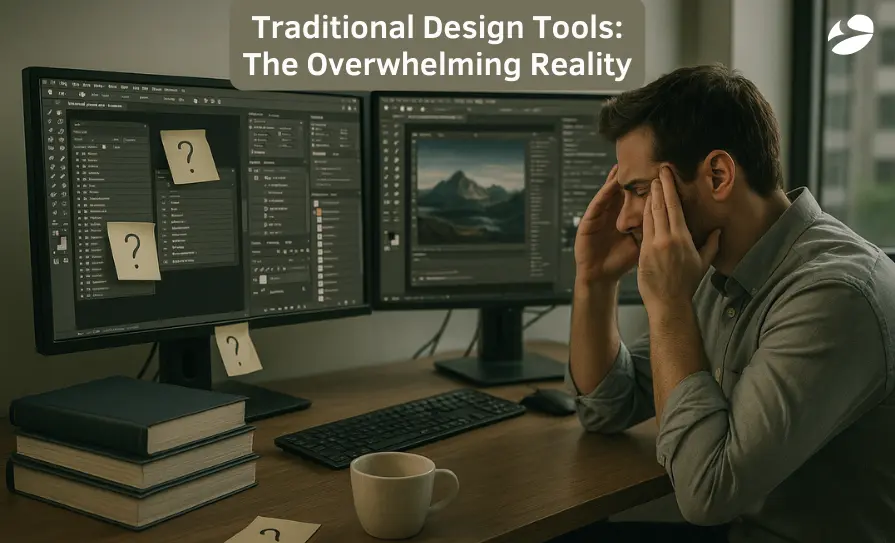
Learning Photoshop is like teaching your goldfish to play chess while blindfolded and on fire. Professional design software requires 200+ hours just to understand why your text keeps disappearing into the void.
Adobe's own training documentation spans 3,000 pages, which explains why marketing teams would rather perform root canals on themselves than create a simple Instagram post. Even teams working on advanced solutions like ai/ml development services joke that Photoshop is still the one tool that feels impossibly over-engineered.
The technical barriers turn every design request into a three-week expedition through menu hell, where even changing a font color requires a PhD in button archaeology.
.
Software licenses alone burn through $600 per user annually, and that’s before counting the $5,000 training courses that teach you which of the 47 blur tools actually work. Companies spend enough on design resources to fund a small space program, yet their social media graphics still look like they were assembled during a power outage.
The bitter irony is that while businesses hemorrhage money on traditional design solutions, competitors using AI tools to create professional visuals without design skills are producing better content for pennies on the dollar. Leadership often asks: “What’s the actual learning curve when we transition our teams to AI design tools?” The answer surprises most — teams typically achieve full productivity within 5-7 business days, compared to the months required for traditional software mastery.
Content production moves at the speed of geological formations because someone needs three days to resize a logo without accidentally turning it into abstract art.
The result is a content pipeline so clogged that by the time visuals are ready, the campaign is as relevant as a fax machine at a tech conference. But here’s what executives often ask: “How quickly can we actually see ROI from switching to AI design tools?”
The data speaks louder than any motivational speaker with a megaphone. Most organizations see measurable returns within 60–90 days. Content production speeds increase by up to 5x while costs drop by nearly two-thirds.
Is your marketing team’s creativity being suffocated by technical limitations and slow design processes? There’s a better way to unleash their potential and accelerate your content pipeline.
Machine learning models process your content in real-time, fixing your visual disasters before they traumatize innocent scrollers on social media. We take this further by developing custom AI algorithms that speak your industry’s specific design language fluently, not like a tourist with a phrasebook.
Our proprietary design intelligence evolves with your brand, learning what converts in your market while competitors still debate whether orange clashes with purple (spoiler: it does). The automated application of best practices means these AI tools can create professional visuals without requiring any design skills. They function like a design team that never sleeps, never complains, and never suggests Comic Sans—ironically.
These automated graphic design platforms for marketing teams adapt content faster than a chameleon on a disco floor, automatically resizing text and images without creating visual train wrecks.
Dynamic layout adjustments happen in milliseconds while traditional designers are still deciding which of their 47 open browser tabs contains the client brief. The AI knows that cramming 500 words into an Instagram post is like fitting an elephant into a Smart car, so it automatically reformats everything actually to work.
Management teams often question: “How much creative control do we sacrifice for this automation?” The reality is there’s no sacrifice. AI tools offer unlimited customization while preventing design disasters—like using seven different fonts in one graphic.
These systems understand how AI simplifies graphic design for beginners by curating images and icons based on context rather than randomly grabbing stock photos of people pointing at invisible computers. The recommendations actually make sense, unlike that time someone suggested using a picture of a smiling salad to represent quarterly earnings.
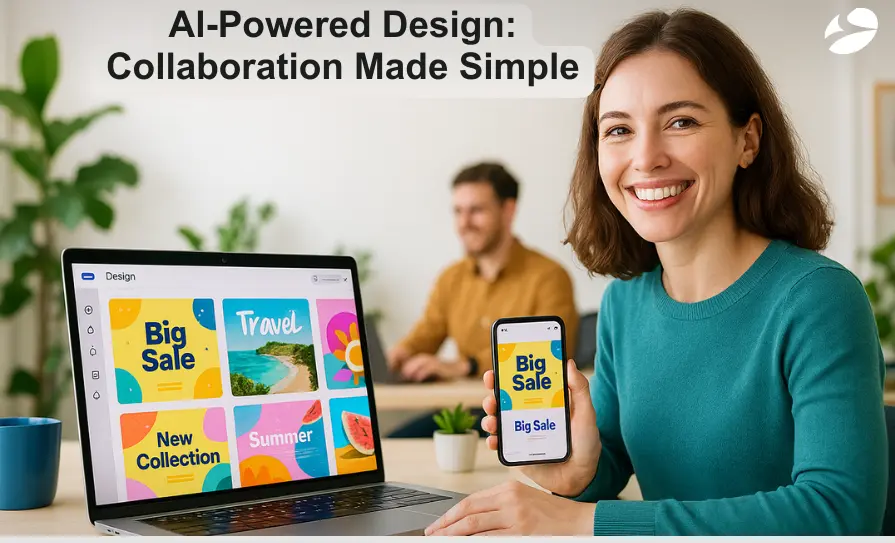
The flexibility within AI-guided frameworks means you can rebel against the machine’s suggestions, though doing so usually ends like arguing with a GPS and ending up in a lake.
AI design tools make it easy to create professional visuals without traditional design skills. They offer built-in guardrails that prevent design missteps while still allowing creativity to flow—like bowling with bumpers, but for visual content.
These AI-based automated design tools for non-designers adapt responsive layouts across platforms. That means your LinkedIn post won’t look like a ransom note when viewed on mobile.
The system optimizes layouts with the precision of a Swiss watchmaker who moonlights as a feng shui master. It creates balance where humans typically unleash disasters that violate every known principle of visual communication.
The automatic application of brand colors and fonts happens faster than you can say, “Why is our logo purple when it should be blue?” It saves countless hours of fixing rogue designs that look like they came from a parallel universe where your brand identity had a midlife crisis.
Logo placement optimization ensures your brand doesn’t end up in corners, where it looks abandoned or stretched, as if it’s being tortured for information. Business leaders managing multiple brands frequently ask: “Can these AI systems handle our portfolio of 15+ sub-brands without creating visual chaos?”
Modern AI platforms manage complex brand hierarchies with dedicated rule sets for each brand, ensuring your luxury line doesn’t accidentally adopt the visual language of your budget offering.
At BiztechCS, we build comprehensive brand management systems within AI design platforms that enforce guidelines with the authority of a hall monitor.
Our ai/ml development services integrate with your existing DAM systems, ensuring brand assets flow seamlessly rather than getting lost in the digital equivalent of the Bermuda Triangle, where good intentions go to die.
The best AI graphic design software for small businesses maintains brand consistency better than a control freak with OCD and a label maker. These tools cost less than the coffee budget for one decent designer, yet produce visuals that don’t scream “made in Microsoft Paint during a lunch break.” Business owners consistently wonder: “What happens when our business scales — do costs explode?”
AI Development Company design platforms don’t scale costs the same way traditional design does. Instead of expenses growing linearly with volume, pricing stays flat even as output increases 10x or 100x. That makes growth financially predictable rather than overwhelming.
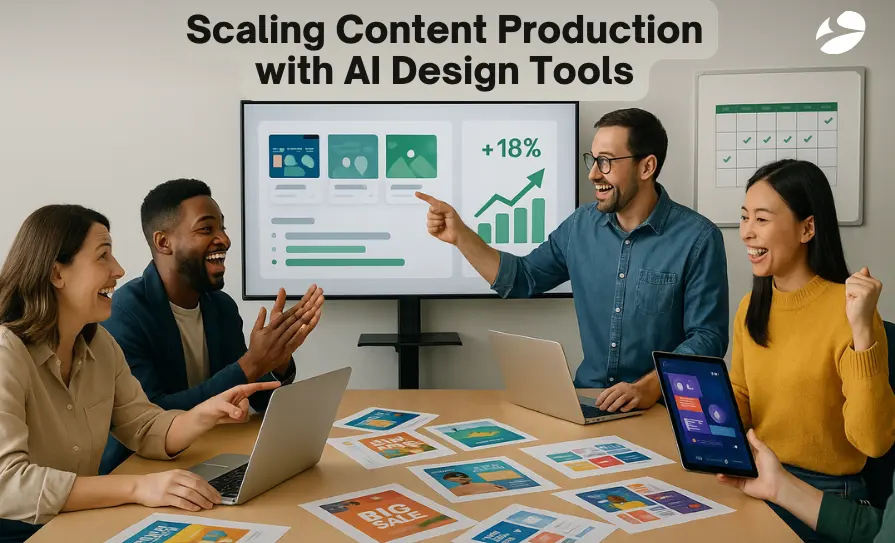
Content production scales from a trickle to a tsunami without hiring an army of designers who communicate exclusively in Adobe Creative Cloud error messages.
These creators produce content that looks expensive while spending less than they do on their daily oat milk matcha lattes.
One retail brand raised social media engagement by 147%, thanks to AI-powered campaign segmentation and design automation (source). Clearly, robots understand aesthetics better than Steve from accounting—who still uses WordArt.
ROI typically hits 300% within six months, making executives happier than finding an empty conference room when they need to take an important call. C-suite executives frequently wonder: “Can we quantify the impact on our creative team’s morale and retention?” Organizations report a 42% increase in designer satisfaction when AI handles repetitive tasks. By automating tasks like endless social graphic resizing, creative teams can focus on strategic brand development.
Continuous feedback loops teach the system what converts and what makes viewers close tabs faster than stumbling onto their ex’s wedding photos. Over time, the adaptive AI becomes smarter than the person who thought gradient text was making a comeback.
Automated compliance checks catch brand violations faster than HR can spot someone using the company credit card at a casino. They maintain standards across teams that previously believed “close enough” counted as a design philosophy.
Our infrastructure scales better than a fish that evolved legs and decided to conquer land. It automatically adjusts resources when your marketing team decides to create 10,000 variations of the same banner ad at 4:59 PM on a Friday.
We implement a microservices architecture in which each component operates independently. That way, when one feature has an existential crisis, it doesn’t drag the entire platform down like a sinking ship full of design dreams.
Our performance optimization strategies ensure your AI-powered design tools for non-designers run faster than employees leaving a meeting that could have been an email.
Our proprietary algorithms learn your sector’s design language fluently, not like a tourist asking where the bathroom is using Google Translate and hand gestures. We develop continuous improvement pipelines that evolve faster than fashion trends, ensuring your AI doesn’t suggest design elements that went extinct with dial-up internet.
At BiztechCS, we specialize in developing enterprise-grade AI design platforms tailored to your industry. They don’t just analyze data—they understand your business better than consultants who charge five figures to tell you what you already know.
At BiztechCS, we develop APIs that integrate with your existing creative tools while maintaining security tighter than a jar lid that nobody in the office can open. Our secure asset management systems prevent unauthorized access better than a bouncer at an exclusive club. Except this bouncer never takes bribes—and actually checks the list. Security-conscious executives invariably ask: “How do we maintain control over sensitive brand assets when using cloud-based AI tools?”
Our enterprise ai/ml development services include on-premise deployment options, granular permission controls, and audit trails that track every pixel modification. These features are designed to satisfy even the most paranoid compliance officers—those who trust no one, including themselves.
These AI-based automated graphic design tools for non-designers deliver 73% faster content production, 68% cost reduction, and 300% ROI, numbers that make spreadsheet enthusiasts weep tears of joy. The democratization of design means everyone from Roger in accounting to the intern who thinks Helvetica is a cheese can create professional visuals without causing retinal damage.
Gone are the days of wrestling with Photoshop like it owes you money or waiting three weeks for a designer to move your logo two pixels to the left. At BiztechCS, we develop custom AI-powered design platforms tailored to your specific needs. If you need a standalone ai/ml development services that outperforms your current chaos —instead of just pretending to—we build it to work seamlessly.
We can build scalable, user-friendly tools that give your entire team design superpowers without the radioactive spider bite or the crushing student loan debt. Let’s discuss how we can revolutionize your design process before your competitors realize they no longer need to sacrifice goats to the design gods.
Are you ready to transform your organization’s design capabilities and leave traditional software limitations in the dust? The future of design is AI-powered, and your competitors are already making the switch.
Artificial Intelligence (AI)
Development
10811

By Devik Gondaliya
Artificial Intelligence (AI)
2815

By BiztechCS

.NET
Artificial Intelligence (AI)
3691
By Devik Gondaliya
You are at the right place.
Projects Completed
Technical Experts
Happy Clients
Years of Experience
Book a free consultation call with us





By submitting this form, you agree to our Terms of Use and Privacy Policy. All information provided will be kept strictly confidential.