5872
Custom Web Application Development: A Complete Guide
7 min read
The most popular applications Facebook, Spotify, Pinterest, Gmail, Netflix, and Amazon are some of the finest examples of custom web applications. In this blog post, you will learn more about custom web app development, its types, benefits, and more!
How Web App Works?
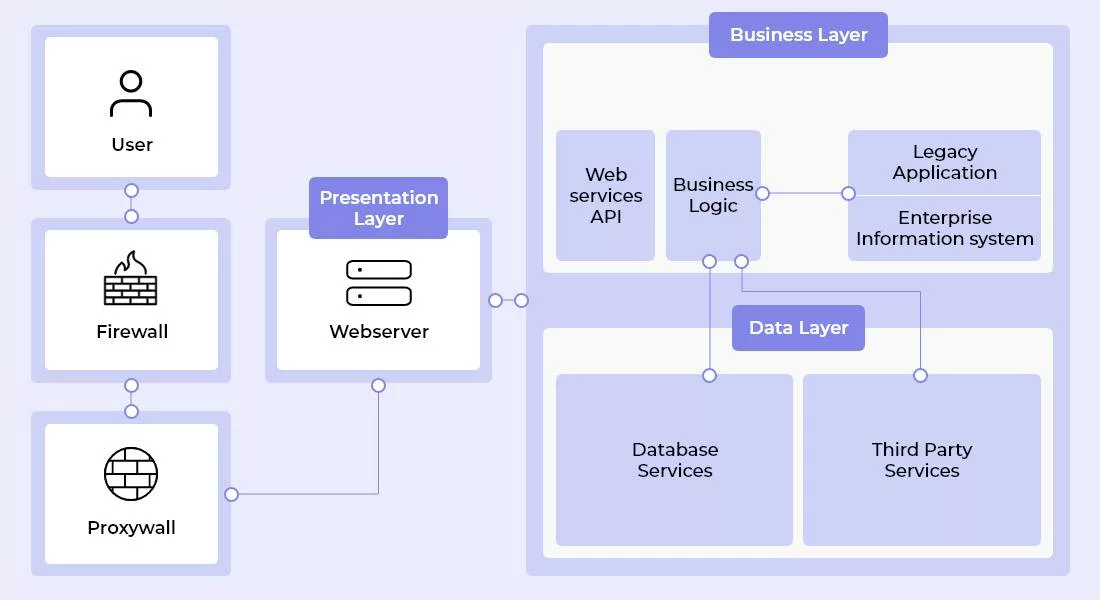
Web applications have a three tier architecture and interacts between 3 software components like application, middleware, and database. Here, the data is processed via HTTP which is understandable by both client side and server side. The architecture enables permission-based authorization and access, seamless creation and manahing of records, and so on.
The below table should help you find answers!
| Web Application | Website |
|---|---|
| Rather complex functions. | Straigtforward functions. |
| Authentication is required for most web apps | There’s no need for authentication in case of websites. |
| Integration with web apps is a bit challenging. | It is easier to integrate other software with a website. |
| You have to pre-compile the web application before it is deployed. | Websites don’t need to be pre-assembled. |
| The interactive online app permits user interaction. | In a website, information transmission is unidirectional and it doesn’t allow user interaction. |
| Regular updates are needed. | Easy to maintain and manage. |
| Features like push notification and offline capabilities. | Offline features are not available. |
I. Static Web App
It is one of the most simple form of web applications and is easier to manage. In this type, the user and server don’t have to communicate with each other. User don’t need to request any information from the server side and the web app content loads on its own in your browser.
Example: A portfolio website, company website
II. Dynamic Web App
Unlike static web apps, dynamic web applications respond to users in real time. These apps are more complex and has several interactive features to engage audience. From simple login and signup features to dynamic content loading, comments, and instant messaging, these apps are known for its dynamic performance and user interaction.
Example: Social media app like Facebook
Technologies Used: ASP.Net, PHP
III. SPAs
Single Page Applications or SPAs are a dynamic app that enable users to connect quickly within a browser. Here, the SPA logic is conducted over a browser instead of a server. Thus, customer requests and interactions happen rather quickly here.
These SPAs develop, debug, and deploy seamlessly.
Example: The best application of SPAs are social networking sites with features like header, sidebar, mailbox, all in a page. Google Mail, Twitter, Netflix, Paypal are some popular examples of SPAs.
IV. Ecommerce Web Apps
With custom web applications development for eCommerce, you can build responsive online stores for your business. Such applications are capable of handling large audience segment and scale accordingly.
Not just that, those are built with online payment integration, transaction integration, mobile commerce, logistics management, internet marketing, and inventory control.
Example: Swiggy, Amazon, Zomato, Walmart, eBay, etc.
V. Multipage Apps
As the name suggests, Multipage web apps consists of multiple pages and each new page reloads from server only when user switches to a different page. You can use some of the best programming languages and technologies like HTML, CSS, AJAX, Javascript, JQuery, etc. to develop such web apps.
Such apps can contain extensive information and scale up without any page restrictions.
Example: Web portals, Catalogs, commercial web apps, online shops, etc.
VI. PWAs
Progressive web apps or PWAs are the most popular kind because they resemble the native mobile applications. Alternatively known as cross-platform web apps, they use progressive enhancement technique and browser API to deliver the native feel.
The prime objective of such PWAs are to deliver improved speed and adaptability.
Example: OLX, MakeMyTrip, Forbes, Starbucks, etc.
VII. Portal Web Apps
Custom web development that allows only verified and approved users access to a portal is used for developing portal web apps. Such applications are used mostly by businesses, corporations, and schools and is open to a limited number of users for operations like content upload, review, chats, and email.
Example: Education portals, Banking portals, customer portals, Employee portals, etc.
Now that you are familiar with the different types of web applications you can build, let’s check the numerous benefits you can leverage.
Here are some basic steps involved with web app development!
Conceptualization
Before involving yourself into the nitty-gritty technical details, you should conceptualize your product. Understand why you are developing a product and what purposes should it serve. Here are a few things you should seek answers to in this phase:
In this phase, you create a wireframe of your product first with all the basic features. You create a clickable prototype to ensure the product is developed appropriately. Once the MVP (Minimum Viable Product) is developed, you can seek for feedback and suggestions from a limited number of audience and improve web app performance.
Testing and Implementation
Testing and debugging is a continuous process that’s taken care of in this phase. You will need to test the web application for security and functionality and implement the feedback received to improve your app’s performance.
Hosting and Maintenance
Finally, you have to choose the hosting server as you prefer. Choose from Shared, Dedicated, or Cloud hosting as suitable and take care of your web app’s hosting.
This is the basic procedure you will need to follow to develop a robust and unique web app. You may as well avail of custom web application development services and seek help from professionals for your web app project.
Pro tip: Choose a tech stack based on the type of web app you are building, your intent, and target audience! The various technologies are Python, PHP, LAMP, Ruby on Rails, React, Angular, Django, Angular, JS, etc.
We are a leading web app development company with skilled developers in various cutting-edge technologies. Connecting with our developers should help you proceed with your web app project.
The most popular applications Facebook, Spotify, Pinterest, Gmail, Netflix, and Amazon are some of the finest examples of custom web applications. In this blog post, you will learn more about custom web app development, its types, benefits, and more!
How Web App Works?
Web applications have a three tier architecture and interacts between 3 software components like application, middleware, and database. Here, the data is processed via HTTP which is understandable by both client side and server side. The architecture enables permission-based authorization and access, seamless creation and manahing of records, and so on.
The below table should help you find answers!
| Web Application | Website |
|---|---|
| Rather complex functions. | Straigtforward functions. |
| Authentication is required for most web apps | There’s no need for authentication in case of websites. |
| Integration with web apps is a bit challenging. | It is easier to integrate other software with a website. |
| You have to pre-compile the web application before it is deployed. | Websites don’t need to be pre-assembled. |
| The interactive online app permits user interaction. | In a website, information transmission is unidirectional and it doesn’t allow user interaction. |
| Regular updates are needed. | Easy to maintain and manage. |
| Features like push notification and offline capabilities. | Offline features are not available. |
I. Static Web App
It is one of the most simple form of web applications and is easier to manage. In this type, the user and server don’t have to communicate with each other. User don’t need to request any information from the server side and the web app content loads on its own in your browser.
Example: A portfolio website, company website
II. Dynamic Web App
Unlike static web apps, dynamic web applications respond to users in real time. These apps are more complex and has several interactive features to engage audience. From simple login and signup features to dynamic content loading, comments, and instant messaging, these apps are known for its dynamic performance and user interaction.
Example: Social media app like Facebook
Technologies Used: ASP.Net, PHP
III. SPAs
Single Page Applications or SPAs are a dynamic app that enable users to connect quickly within a browser. Here, the SPA logic is conducted over a browser instead of a server. Thus, customer requests and interactions happen rather quickly here.
These SPAs develop, debug, and deploy seamlessly.
Example: The best application of SPAs are social networking sites with features like header, sidebar, mailbox, all in a page. Google Mail, Twitter, Netflix, Paypal are some popular examples of SPAs.
IV. Ecommerce Web Apps
With custom web applications development for eCommerce, you can build responsive online stores for your business. Such applications are capable of handling large audience segment and scale accordingly.
Not just that, those are built with online payment integration, transaction integration, mobile commerce, logistics management, internet marketing, and inventory control.
Example: Swiggy, Amazon, Zomato, Walmart, eBay, etc.
V. Multipage Apps
As the name suggests, Multipage web apps consists of multiple pages and each new page reloads from server only when user switches to a different page. You can use some of the best programming languages and technologies like HTML, CSS, AJAX, Javascript, JQuery, etc. to develop such web apps.
Such apps can contain extensive information and scale up without any page restrictions.
Example: Web portals, Catalogs, commercial web apps, online shops, etc.
VI. PWAs
Progressive web apps or PWAs are the most popular kind because they resemble the native mobile applications. Alternatively known as cross-platform web apps, they use progressive enhancement technique and browser API to deliver the native feel.
The prime objective of such PWAs are to deliver improved speed and adaptability.
Example: OLX, MakeMyTrip, Forbes, Starbucks, etc.
VII. Portal Web Apps
Custom web development that allows only verified and approved users access to a portal is used for developing portal web apps. Such applications are used mostly by businesses, corporations, and schools and is open to a limited number of users for operations like content upload, review, chats, and email.
Example: Education portals, Banking portals, customer portals, Employee portals, etc.
Now that you are familiar with the different types of web applications you can build, let’s check the numerous benefits you can leverage.
Here are some basic steps involved with web app development!
Conceptualization
Before involving yourself into the nitty-gritty technical details, you should conceptualize your product. Understand why you are developing a product and what purposes should it serve. Here are a few things you should seek answers to in this phase:
In this phase, you create a wireframe of your product first with all the basic features. You create a clickable prototype to ensure the product is developed appropriately. Once the MVP (Minimum Viable Product) is developed, you can seek for feedback and suggestions from a limited number of audience and improve web app performance.
Testing and Implementation
Testing and debugging is a continuous process that’s taken care of in this phase. You will need to test the web application for security and functionality and implement the feedback received to improve your app’s performance.
Hosting and Maintenance
Finally, you have to choose the hosting server as you prefer. Choose from Shared, Dedicated, or Cloud hosting as suitable and take care of your web app’s hosting.
This is the basic procedure you will need to follow to develop a robust and unique web app. You may as well avail of custom web application development services and seek help from professionals for your web app project.
Pro tip: Choose a tech stack based on the type of web app you are building, your intent, and target audience! The various technologies are Python, PHP, LAMP, Ruby on Rails, React, Angular, Django, Angular, JS, etc.
We are a leading web app development company with skilled developers in various cutting-edge technologies. Connecting with our developers should help you proceed with your web app project.
Artificial Intelligence (AI)
Development
10811

By Devik Gondaliya

Development
ERP
2796
By Devik Gondaliya
Artificial Intelligence (AI)
Development
52808
By Devik Gondaliya
You are at the right place.
Projects Completed
Technical Experts
Happy Clients
Years of Experience
Book a free consultation call with us





By submitting this form, you agree to our Terms of Use and Privacy Policy. All information provided will be kept strictly confidential.