
AWS vs Azure: Which Cloud Platform to Choose in 2026?
10 min read
AWS was the first to step into the arena in 2006, offering more than just retail strength. In 2010, Microsoft responded to AWS with its Azure platform, leveraging years of experience in delivering enterprise-grade solutions. And it was a rapid change ever since.
AWS offers limitless scale and a broad variety based on an underlying robust infrastructure, while Azure responds with a high level of Microsoft integration and ease of use. For organizations looking to harness this power effectively, AWS cloud consulting services can play a crucial role in aligning cloud capabilities with strategic goals.
Thus begins the debate between Amazon Web Services (AWS) and Microsoft Azure. Which is best, Azure or AWS? Here is a guide to help you make the best choice for the organization.
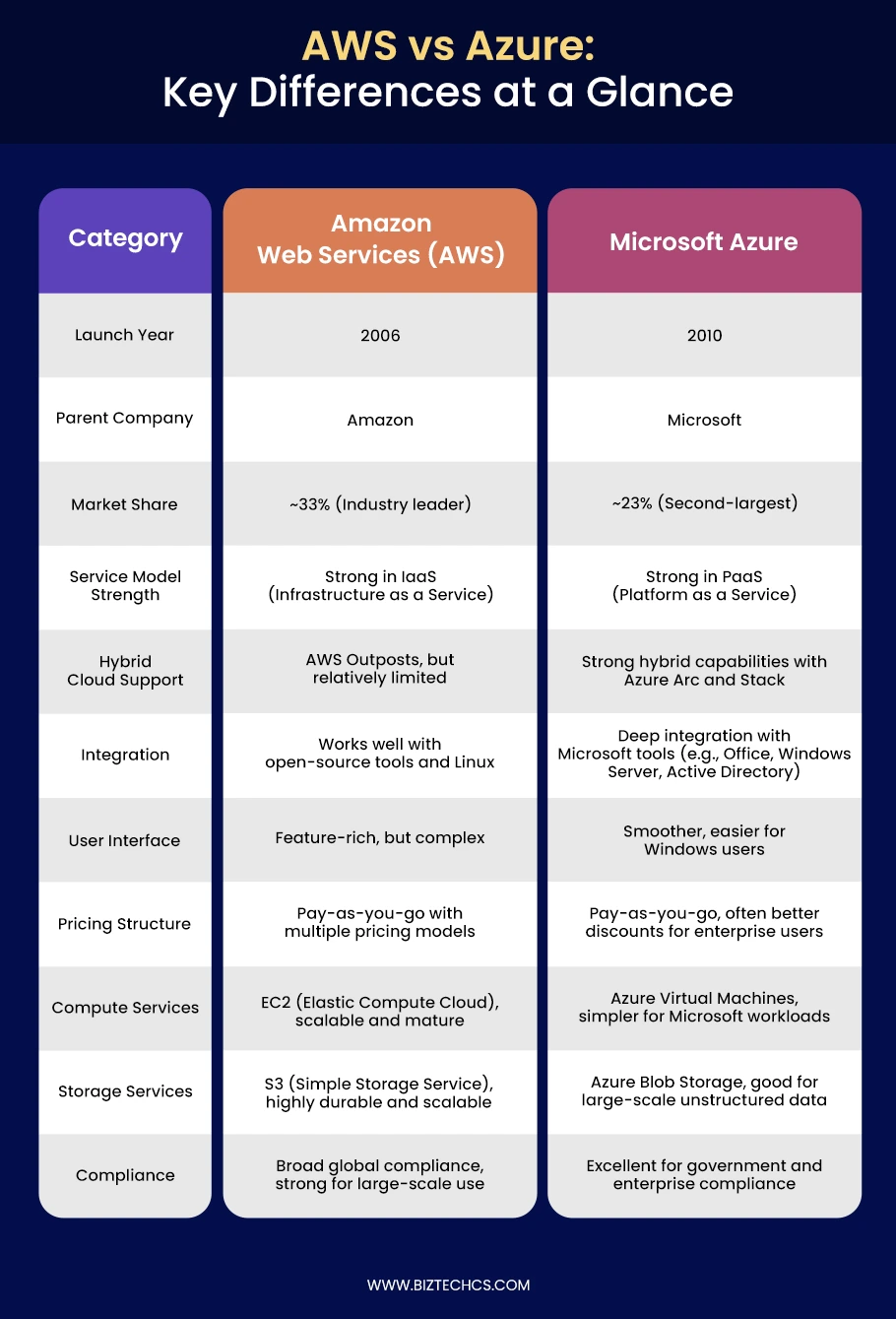
Azure has its counterpart in Virtual Machines, which are used for running Windows and Linux. Azure Functions is great for running serverless code on demand in response to events.
In terms of container requirements, Azure’s stronghold is Azure Kubernetes Service (AKS), which is particularly known for its excellent integration with developer tools and pipelines.
Azure’s equivalent is Blob Storage, which is ideal for storing unstructured data, such as audio and video files.
Considering Azure Disk Storage, it allows high-performance applications. Azure Archive Storage, on the other hand, is designed for infrequent data access at a lower cost. Every platform offers storage that can scale with your business.
Fully managed relational solution, Azure SQL Database. Cosmos DB has a global footprint and multiple NoSQL models.
Both have data integration with superior analytical capability available in a low-cost service, Azure Synapse Analytics. Both provide database tools according to scale, performance, and compliance requirements.
Azure offers enterprise-class services via a machine learning environment for model creation and deployment. Its wide-ranging API set as including vision, speech, and language, provides ready-made services.
The Exchange’s Bot Services offer integrated, AI-enabled conversational interfaces. Thus, both cloud platforms laud having intelligent solutions across the applications and services.
Azure prevails primarily in regions, operating data centers in over 60 geographical locations worldwide. This reduces latency for end users and helps organizations achieve local compliance. Both cloud platforms are equipped to support enterprises in their geographical expansion through their enterprise-grade infrastructure and redundancy.
Azure is also dependent on the pay-as-you-go method; however, unlike AWS, it charges by the minute on most services, with its built-in cost management tools that help monitor usage and set budgets. Both platforms ensure that you’re paying for what you use, which is best for dynamic workloads.
Azure has a similar Reserved VM Instances model, with savings of up to 72% for one- or three-year commitments. Azure RIs might also be exchanged or canceled for other VMs, increasing flexibility in long-term planning. Both models reward commitment with substantial cost savings.
Azure has a pretty similar model called Low-Priority VMs (now merged with Spot VMs). These VMs are incentivized and may get evicted at any time based on capacity needs. Both models provide savings for temporary or workload-based marketing.
There are also a few services on Azure that are free for an unlimited time, subject to usage limits. These free offerings enable companies to test their cloud capabilities before scaling up.
This is also supported by Azure integration with Power BI for more advanced cost analysis. Thus, both give transparency and control to manage cloud budgets efficiently.
Azure enables easier transitions for corporates already invested in the Microsoft ecosystem by reducing installation and compatibility headaches.
Granted, even AWS is compatible with Microsoft workloads, but a consolidation may require an added effort to configure the link. Essentially, if licensing and hybrid solutions within on-premises environments remain vital for your business, Azure is the more efficient option.
Its structures are also mature and stable, supporting businesses in finance, healthcare, and logistics.
All those features make Azure robust; however, much of what Amazon would offer would fit into edge and developer tools without matching the scale for most Azure services.
If your business rewards certain aspects, such as innovation, personalization, or unique workloads, AWS development services would likely better meet those requirements.
While Microsoft Azure may cover more countries or territories, AWS provides multiple zones within each region. Both are excellent in providing global infrastructure, but AWS has unmatched uptime and resilient services. If your business plans to scale internationally with instant access, AWS is an ideal choice.
Azure offers strong AI tools in Azure Machine Learning and Cognitive Services. They are user-friendly tools and suitable for businesses new to the world of AI.
With the substantial long-term investment in inward data science teams, which brings about custom AI development, AWS may provide greater depth of control.
Nevertheless, the integration of Azure in a shorter period and the use of low-code AI are good examples of its simplicity and speed.
Although AWS supports hybrid deployments, it would likely require additional external tools or effort to achieve the native hybrid capabilities of Azure.
This easier hybrid consideration is significant in regulated fields or environments with a lot of legacy. On the whole, Azure cloud deployments are more streamlined for businesses undergoing phases of transition or needing consistent tool usage across cloud and on-premises.
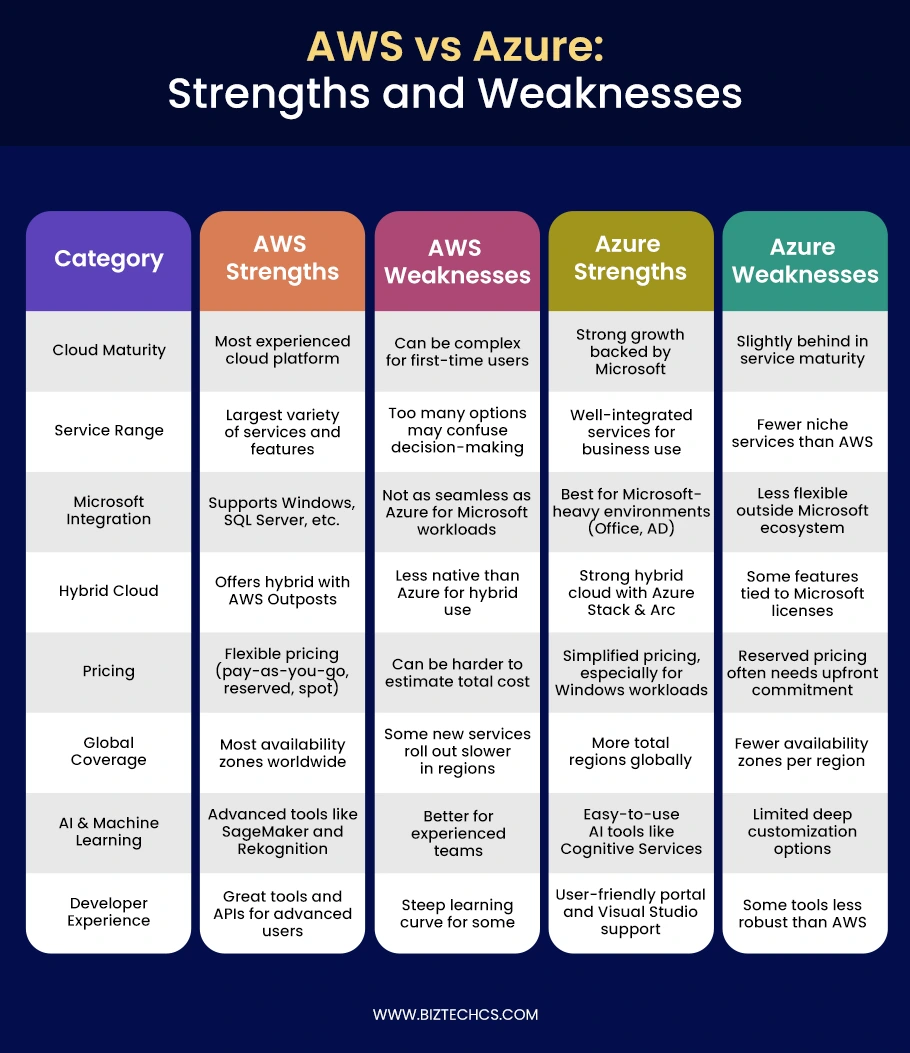
Conversely, if more service variety and further customization are needed, Amazon Web Services Cloud is wider in this area. Both are strong; however, the difference lies in how the long-term view is established and how the skills are allocated internally.
The difference between setting it up with AWS vs Azure will pay for itself in case of replacement at some point. The best answer to the question, which is better, Azure or AWS, is it depends on how well both fit your business, since neither has more features than the other.
AWS supports this method through the AWS Migration Hub and Server Migration Service. In contrast, Azure typically offers a rehosting pathway with Azure Migrate for easy migration of virtual machines or servers.
This approach is most effective when companies need to rapidly reduce their costs for on-premises infrastructure. Minimal change for immediate results with maximum core business intact.
Azure provides Azure Functions, Logic Apps, and Cosmos DB to help re-architect scale applications. This option is more time-intensive but will allow you to leverage cloud features more effectively.
This is a better strategy if your business demands flexibility, speed, and resilience from its software.
Both AWS and Azure have tools to help you do just that. It is rehosting and full refactoring. This strategy reduces cloud costs, enhances performance with minimal risk, and is a smart step when your application is stable but requires minor adjustments.
AWS also has a pretty solid integration with some popular third-party SaaS offerings. This option helps businesses cut maintenance and licensing costs. This approach is most effective when your current software is outdated or difficult to support.
Both AWS and Azure have hybrid setups to help manage such scenarios. This strategy starts with an analysis of which systems add value and which do not. This can help organizations be lean, compliant, and focused on the systems that truly matter.
As AWS continues to expand services like SageMaker and Bedrock to support model deployment for custom AI, Azure focuses on OpenAI and broadens its Cognitive Services by making them more industry-specific. For organizations seeking to leverage these capabilities effectively, partnering with an experienced Azure development company can streamline the integration of advanced AI and cloud solutions.
Sustainability is a focus—and both were true: Engine’s data centers will become green data centers and energy-efficient infrastructure. Hybrid and multi-cloud platforms seem to be expanding, and as a result, will be used by more companies, leading to simplified, cross-platform solutions.
Over time, we can expect to see more advanced security models, more intelligent analytics, and additional cost-control features that enable customers to achieve “more with less.”
[display_faq]
You are at the right place.
Projects Completed
Technical Experts
Happy Clients
Years of Experience
Book a free consultation call with us





By submitting this form, you agree to our Terms of Use and Privacy Policy. All information provided will be kept strictly confidential.