
Role of Artificial Intelligence in Education 2026
10 min read
10 min read
Then, a simple yet powerful change was made: a principal introduced an AI grading tool. The result? Teachers reclaimed nearly 7 hours weekly, and student performance surged by 18% in test scores and participation. This shift was not just a one-off success; it’s becoming a standard across schools, with 47% of education leaders now using AI tools daily (source).
In this blog, we explore how AI is no longer a futuristic concept but a transformative force in today’s education system, driving real-world classroom and administration improvements, with the support of IT solutions for education industry.
From machine learning to natural language processing and computer vision, these technologies now drive tools that assist students in learning more efficiently and enable staff to prioritize high-impact work.
The future of AI in education is not to supplant teachers but to aid them, enhancing efficiency without sacrificing quality. Two dominant uses have gained momentum: academic enrichment and operational effectiveness.
In one instance, an average-sized university utilized AI-powered analytics to decrease student dropouts by detecting risk indicators at the earliest stages. This is part of a broader transformation; based on EY, the take-up of AI within education sector organizations is gathering pace because it has delivered proven results in domains such as performance monitoring and student guidance (source).
Artificial intelligence applications within education are already having a material impact — subtly but firmly — on how institutions educate, care for, and develop.
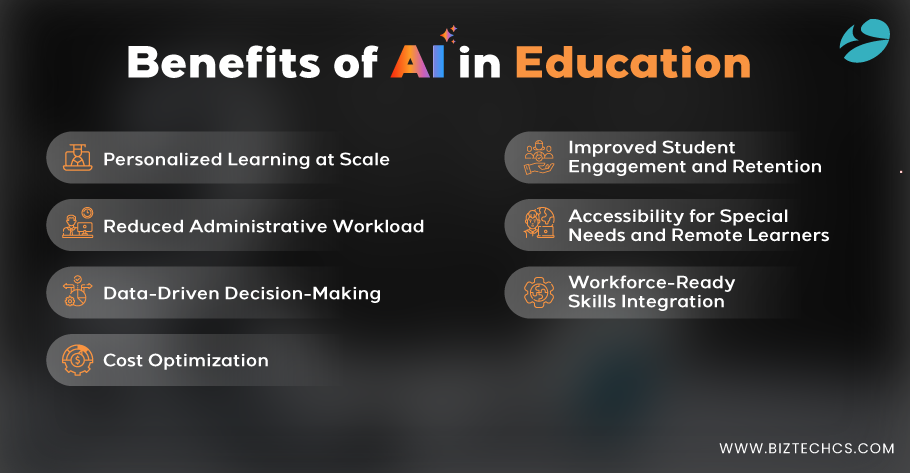
One school in Singapore noticed better exam results just by utilizing AI-powered learning platforms for a single semester. This indicates how AI applications in education can result in more targeted and inclusive instruction.
This AI system took over repetitive tasks like answering routine questions, managing scheduling, and filling out forms. As a result, the remaining staff could allocate more time to strategic student support, academic planning, and engagement.
This not only saved time and resources but also improved service quality. The efficiency gained through AI applications is one of the most practical and impactful changes in education today, proving that AI supports the learning environment and enhances operational effectiveness.
For example, by tracking attendance and engagement patterns, AI can promptly flag when a student is at risk of falling behind, such as after missing two consecutive days of class. This early warning system enables teachers and administrators to intervene quickly, offering the necessary support to keep the student on track.
As a result, students receive timely assistance, improving their overall engagement and academic performance. This proactive approach to student support helps prevent issues like disengagement or dropout, ensuring every student stays involved and succeeds in their learning journey.
For instance, one school utilized this information to restructure its schedule, enhancing both faculty productivity and student achievement. That’s the actual effect of AI on education: faster, better-informed responses. It makes sense of messy systems without the guesswork.
These applications erase barriers silently but surely. They’re not confined to graduate campuses—they’re already deployed in public schools and smaller universities. The work of AI in schools is very human.
These transitions didn’t require significant investments, but they highlight just a few of the ways AI in the education industry can deliver long-term savings through targeted, small-scale changes.
Even a vocational school allows AI to recommend modules based on new jobs in tech and healthcare. Students have a better roadmap. And institutions remain germane in a rapidly evolving marketplace — one of the lesser-seen facts regarding AI in schools, but one imbued with profound worth.
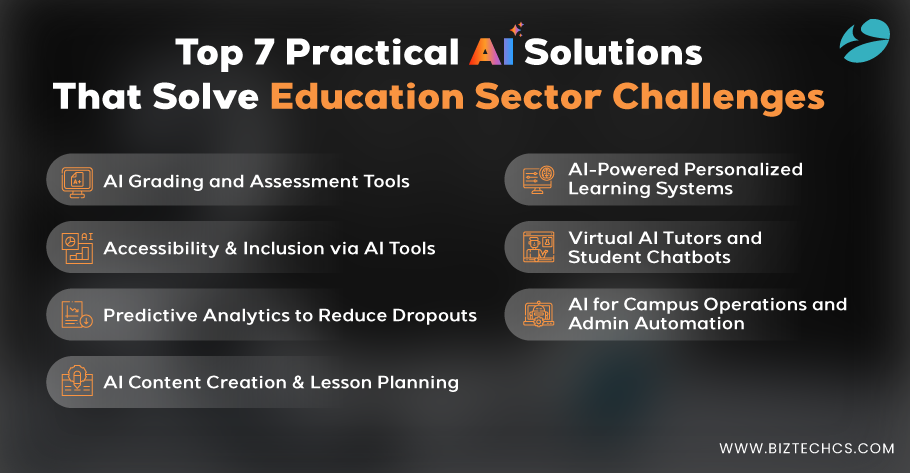
The AI reviewed answers and changed the assignments’ difficulty level in real time. Students who required extra time were given extra help, while others could proceed without delay.
The payoff was instant: a 30% retention boost and better exam scores overall. This shows how AI in education can make every student’s learning experience more tailored to their needs.
Key Benefits:
Teachers gained over 5 hours of free time weekly, and students had faster feedback. Consequently, the general classroom experience was enriched, with more time devoted to interaction and support. This is a straightforward case on how the use of AI in learning can maximize efficiency and speed of feedback.
Key Benefits:
The chatbots could respond to frequently asked questions, assist students with assignments, and even offer career guidance. With 24/7 AI tutors, the school experienced lower dropout rates and higher student satisfaction.
They offer 24/7 support, which helps students remain on track. Education with AI enables ongoing assistance so no student will feel left behind.
Key Benefits:
The AI handled repetitive functions, ensuring the right scheduling and sending reminders on time. Students, staff, and faculty could allocate more time towards education and communicating with students rather than task repetition.
The institution experienced increased operational effectiveness and administrative cost savings over time. This is a fine example of artificial intelligence solutions in education that optimize campus operations.
Key Benefits:
The system recognized students who were in danger of dropping out, and the staff was able to step in early. This proactive approach resulted in a 40% reduction in dropouts.
The college could intervene at the right time by catching and resolving issues early, before they turned into crises. This is one clear example of how AI affects education, using data to make decisions that prevent student loss.
Key Benefits:
The AI saved teachers’ prep time and ensured that the content was consistent and focused on learning objectives. Teachers could now spend their time interacting with students, instead of wading through resources galore. This improved classroom productivity, with more time for students and experiential teaching. AI not only saves time, but it also improves lesson quality and uniformity.
Key Benefits:
By incorporating AI-driven tools such as real-time transcription, auto-translation, and captioning, the school could equalize the playing field for all students.
These tools enabled students to access the same content, irrespective of their physical capabilities or language skills. The outcome was an inclusive learning experience, with each student able to engage to their full potential.
AI technologies didn’t merely boost learning; they ensured fair access to education for all students, addressing diverse requirements.
Key Benefits:
AI tracks student responses and adapts the learning environment on the fly. The possibilities are endless, from scuba diving to explore the underwater world to taking a helicopter tour over the Egyptian pyramids.
Education in the future will be marked by such experience-based learning, where students don’t just learn theory, but live through the environment they are trying to understand.
With this technology, teachers get instant feedback about student engagement. If a learner begins to tune out, the AI can nudge the teacher to shift the lesson or provide extra support. This change will enable more customized learning in real time, where emotions dictate the speed of instruction.
The use of AI in education will be crucial in maintaining students’ interest, motivating them, and keeping them on course.
Teachers can focus more on developing creativity and critical thinking, as AI can handle repetitive work. Indeed, such AI assistants will even generate personalized quizzes and study guides for students based on their learning patterns.
In the near future, AI will be an indispensable companion in the classroom, assisting teachers in improving education for everyone.
These models should be engineered to explain decision-making processes and help students and educators understand why things happen.
For instance, AI will identify when particular groups are disadvantaged by algorithms so that adjustments can be made without delay. As AI’s influence on education expands, making these systems ethical will ensure that people trust technology.
Institutions will require transparent policies that dictate how AI models function to provide equity and fairness in all decisions.
With AI-driven tools, every student can now learn at their own pace, thanks to personalized learning. Teachers, relieved of the time-consuming grading and administrative tasks, can spend more time on student interaction and encouraging creativity.
Predictive analytics is enabling institutions to identify students who are at risk so that interventions can take place ahead of time, and dropout rates can be decreased. The future for education looks bright, with AI making the learning environment more inclusive, efficient, and effective.
By integrating AI-driven solutions with higher education ERP systems, institutions can streamline their operations while enhancing student experiences.
At BiztechCS, we have extensive experience integrating AI-driven solutions into educational frameworks, streamlining teaching and administrative processes.
Our expertise helps institutions leverage the power of AI to enhance learning experiences, improve student retention, and boost operational efficiency.
By partnering with us, educational organizations can embrace the future of AI in education and ensure they remain competitive and innovative in a rapidly evolving sector.

Artificial Intelligence (AI)
Development
10811

By Devik Gondaliya
Artificial Intelligence (AI)
2815

By BiztechCS
.NET
Artificial Intelligence (AI)
3691
By Devik Gondaliya
You are at the right place.
Projects Completed
Technical Experts
Happy Clients
Years of Experience
Book a free consultation call with us





By submitting this form, you agree to our Terms of Use and Privacy Policy. All information provided will be kept strictly confidential.