
1860
Custom Software Development Cost Guide 2026
7 min read
Custom software is tailored to meet your unique needs and is comparatively a better choice than off-the-shelf solutions. However, the custom software development cost tends to be on the higher end because it is tailored to meet your precise requirements, enabling you to achieve unmatched efficiency, innovation, and scalability.
So, if you are planning to build a custom software solution, it is better to know all the associated costs of custom mobile app development beforehand.
With the help of this all-inclusive guide, we shall help you understand how the costs will vary for a custom project and what factors will affect your project budget.
So without further ado, let’s jump in!
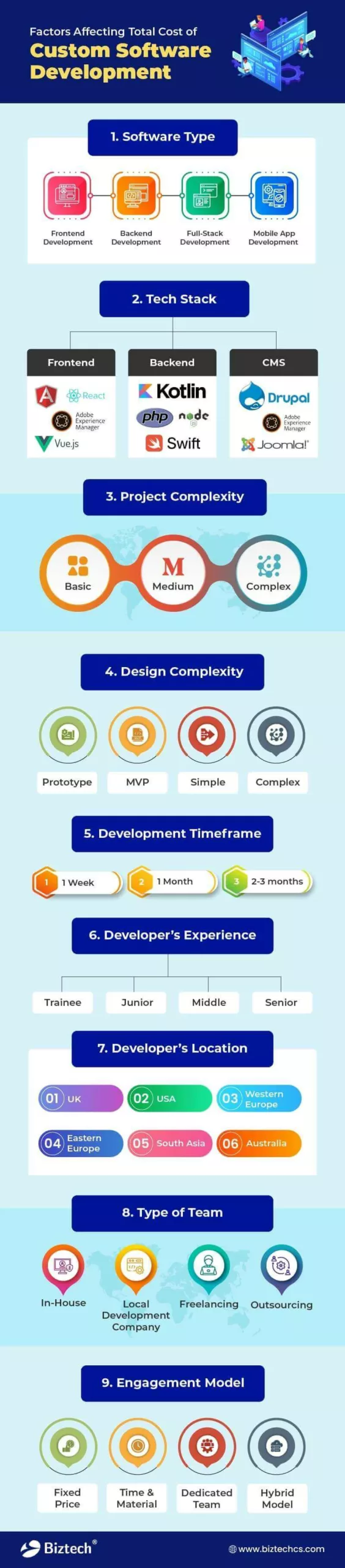
Understanding the intricate web of factors influencing the cost of custom software development is paramount. From project scope and complexity to technical specifications and ongoing maintenance, these cost considerations shape the feasibility of a project and its long-term impact on the organization’s resources.
By grasping the significance of these cost factors, businesses like yours can make informed decisions, allocate budgets wisely, and ensure successful project outcomes that align with your strategic goals.
| Developer Experience Level | Yearly Hiring Cost (in $) |
|---|---|
| Trainee | 60,000 |
| Junior Developer | 70,000 |
| Mid-Level Developer | 90,000 |
| Senior Developer | 120,000 |
| Software Architect | 145,000 |
| Development Type | Cost/Hour (in $) |
|---|---|
| Frontend Development | 120 |
| Backend Development | 150 |
| Full-Stack Development | 130 |
| Mobile App Development | 140 |
| Developer Region | Yearly Hiring Cost (in $) |
|---|---|
| USA | 200,000 |
| UK | 140,000 |
| Australia | 120,000 |
| Western Europe | 120,000 |
| Eastern Europe | 70,000 |
| South Asia | 30,000 |
Honestly, these can be a lot while deciding on the project budget; more the reason why most software project estimates go wrong.
Let’s check a few reasons why businesses struggle to estimate project budgets appropriately.
I. Inaccurate Planning
You need to plan your project scope first before deciding on the project budget. If you fail to plan the project scope considering all the aforementioned factors, it can lead to inaccurate budget estimates.
II. Incomplete Requirements
In case you hire dedicated developers from a team, they will give you a budget estimate based on your requirements. However, most companies fail to convey all of their requirements clearly to the development team and change project scope later. Consequently, the project budget also varies, leading to inaccurate budget estimation.
III. Unprecedented Technical Challenges
Certain technical challenges, the need to adopt new technology, the scope for integrating new tools, etc. also impact the project budget at times.
IV. Evolving Technology Landscape
The constant change in the technology landscape can also impact the cost of custom software development.
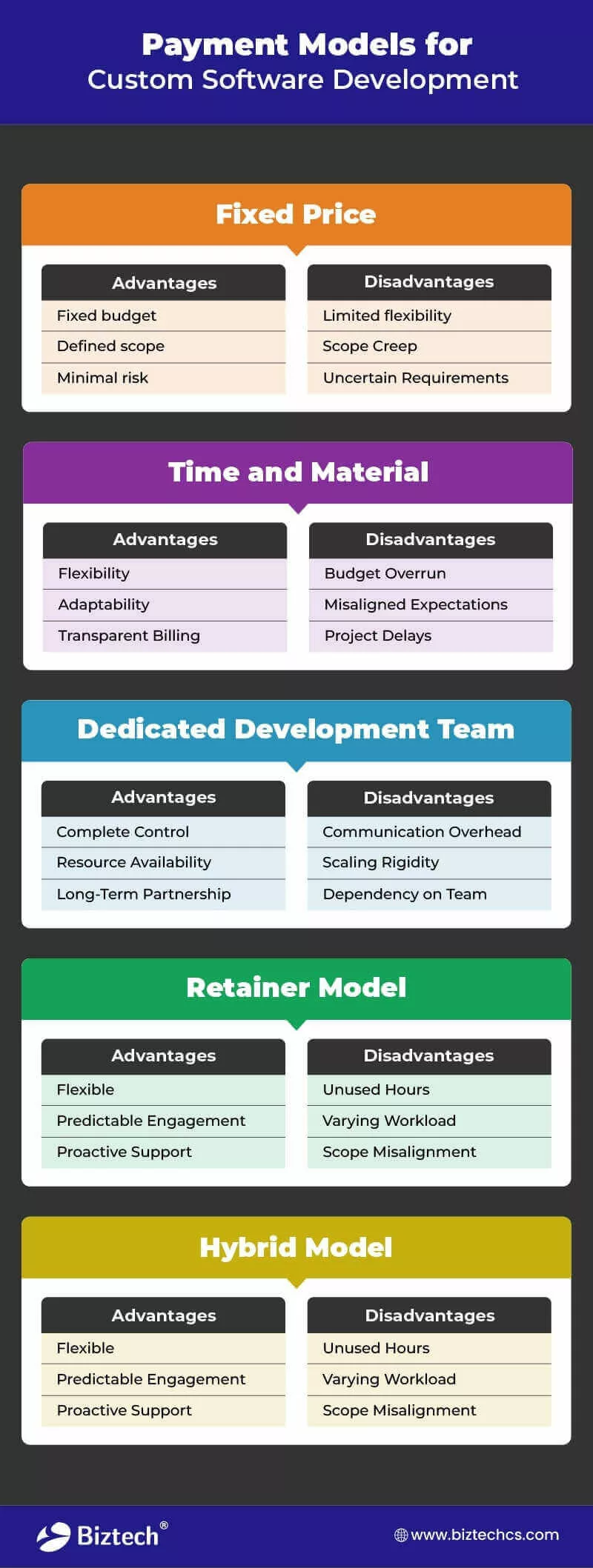
There are several payment models commonly used for software development projects, each with its own advantages and considerations. Depending on these models, the software development costs vary far and wide.
Here are the main payment models:
Advantages of Fixed Price Model:
The billing is based on hourly/daily rates. So, the developers and designers are paid for the hours worked. It is apt for projects where incremental development is needed.
Advantages of T&M Model:
Advantages of Dedicated Team Model:
Advantages of Retainer Model:
Advantages of Hybrid Model:
Step 1: Define Project Scope
First, analyze your project needs, competitor market, and target audience to determine your project scope. It should help you define the project scope with all its goals, features, and functionalities. When you approach a company, they will look at the project scope and tell you the product development cost.
Step 2: Estimate Effort
When developing a custom software project, you have a lot of tasks to take care of right from designing and development to testing and QA. Establishing all the various tasks required in the project will help estimate the efforts (number of hours/ days) required to complete a project.
Step 3: Calculate Various Types of Costs
Product development costs aren’t the only ones for you to consider. Let’s look at the various types of costs involved in custom software development.
I. Development costs (Cost of hiring)
II. Infrastructure costs (Hardware and software acquisition costs, cloud services cost)
III. Tools and licensing costs (Costs for debugging tools, version control systems, IDEs, performance monitoring software, testing tools)
IV. Project management costs (Communication tools, ERP/CRM tools, cost to hire project managers, etc.)
V. QA costs (If you are handling the project with an in-house team)
VI. Deployment and integration costs (Cost for APIs, third-party systems, deployment tools, etc.)
VII. Documentation costs (Cost for preparing training materials, API documentation, technical guides)
VIII. Change management costs (Costs for revisions and iterations or change in project scope)
IX. Operational costs (Cost of maintaining software, performance, database management, data security)
X. Consultation costs (Some companies may charge a nominal consultation fee)
XI. Maintenance and support costs (Expenses related to post-deployment support, update, maintenance, iterative development)
Step 4: Estimate Contingencies
Add a contingency buffer to account for unexpected issues or changes in requirements. This buffer helps mitigate risks and ensures a more accurate custom software development price estimate.
Step 5: Factor in Time
Estimate the time required for each task and the overall project timeline. Consider dependencies, testing phases, iterations, and potential delays.
Step 6: Consult Software Development Agencies for a Quote
Whether you want to avail CMS development services or custom web or mobile development services, you must choose a potential team that can help you in this pursuit. Shortlist a few contenders based on your preference and consult them to get a quote.
Note that you will have to document your project scope, keep it ready, and share it with them.
Step 7: Negotiate and Finalize
Now, it is time for negotiations. You can decide on your preferred engagement model and negotiate charges with the company. Negotiate any necessary adjustments to the estimates. Once both parties agree, finalize the project cost and terms.
Step 8: Sign a Deal
Make sure you sign a contract specifying all the terms and conditions as you prefer. Thus, you will have minimized risks and get to develop custom software as per your needs.
If you have an in-house team working on your custom software development project, you will need to consider all the factors that influence the cost. However, you don’t have to get involved with these nitty-gritty details when you outsource the software development project to a professional team.
Are you still looking for an expert team of skilled developers who can help with custom software development? Then, BiztechCS might be the right company for you. With our 16+ years of experience and exposure to 1200+ projects, we bring the best talent to help you develop innovative yet affordable software solutions.
Want to learn more about our cost estimation? Let’s check in detail!
From open-source to proprietary, engagement models to project estimates, each facet contributes to the puzzle of custom software development costs. By navigating this guide, you should gain a compass to navigate the financial terrain of your software ventures.

Artificial Intelligence (AI)
Development
10811

By Devik Gondaliya

Development
ERP
2796
By Devik Gondaliya

Artificial Intelligence (AI)
Development
52808
By Devik Gondaliya
You are at the right place.
Projects Completed
Technical Experts
Happy Clients
Years of Experience
Book a free consultation call with us





By submitting this form, you agree to our Terms of Use and Privacy Policy. All information provided will be kept strictly confidential.