728
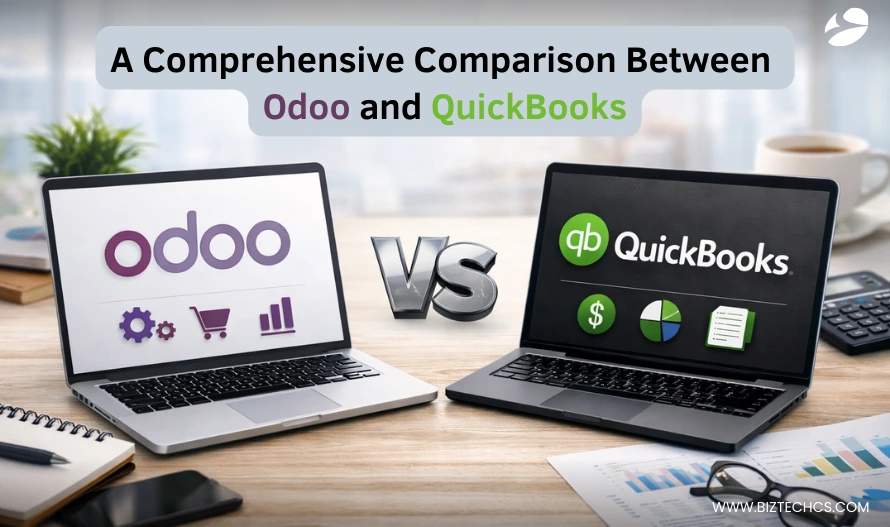
A Comprehensive Comparison Between Odoo and QuickBooks
5 min read
Choosing software feels like picking a spouse. You want reliability. You also hope it doesn’t make you cry every Tuesday. Odoo and QuickBooks are the two heavyweights in this ring. One is a sleek Swiss Army knife for your entire office.
The other is a world-class calculator that refuses to do anything else. Settling for the wrong one is a recipe for disaster. In fact, 6 in 10 users say their online accounting or finance tool comes with challenges or limitations that hold them back (source). This is especially common among small businesses as they grow and financial needs become more complex.
Many teams outgrow their financial tools within just two years. This happens when the “simple” tool becomes a bottleneck. You need more than just balance sheets — you need systems that scale with your business.
You need a system that breathes with your sales, inventory, and HR. This guide tears down the walls between specialized accounting tools and all-in-one ERPs. Whether you need a simple ledger or a massive Odoo ERP migration, making the right call now saves your sanity later.
According to Ledger Labs, Odoo’s automation can save teams 10+ hours weekly. That is a lot of extra coffee breaks. Let’s find out which one keeps your business in the black without the grey hairs.
On the other side of the ring, QuickBooks remains the specialized accounting darling that sticks to its guns, focusing almost exclusively on making sure your debits and credits don’t start a civil war. While QuickBooks is a cozy fit for startups that just need to survive tax season, larger organizations often find its rigid walls and 25-user cap a bit like wearing a toddler’s shoes to a marathon.
Opting for Odoo ERP migration is often the only way to escape the manual data-entry loop and the “spreadsheet hell” that kills productivity. Transitioning via Odoo Data Migration ensures your financial history isn’t left behind in a dusty, limited ledger while you scale toward global domination.
Using Odoo migration services turns the terrifying leap into a structured walk in the park, giving you a unified system where departments actually speak the same language.
Are you tired of your team operating in silos because your current software can’t keep up with your growth? It’s time to stop letting rigid limitations dictate your business’s ceiling.
Accuracy isn’t a luxury when 89% of finance leaders admit to making monthly decisions based on flawed data, which is a recipe for a professional meltdown. Moving from clunky local installations to the cloud is no longer a trend; it is a survival tactic. In fact, cloud-based tools can slash bookkeeping costs by up to 40% while keeping your data safe from that one employee who always spills coffee on the server.
Most modern firms now treat “on-premise” like a flip phone—nostalgic but useless. Leveraging Odoo ERP migration allows you to trade fragmented local files for real-time clarity. By utilizing Odoo data migration, you ensure your legacy numbers don’t haunt your future growth.
Professional Odoo migration services make this transition smoother than a freshly reconciled bank statement.
| Feature | Odoo | QuickBooks |
| Bank Reconciliation | • Supports both manual and automated reconciliation
• Handles multiple bank accounts seamlessly • Advanced transaction matching and control for complex operations | • Primarily automated reconciliation
• Simple setup and usage • Identifies discrepancies but offers limited customization |
| Billing & Invoicing | • Fully integrated invoicing within ERP ecosystem
• Highly customizable invoice templates and workflows • Direct integration with inventory, CRM, projects, and accounting | • User-friendly invoicing designed for small businesses
• Quick invoice creation and tracking • Integrates with payroll and POS systems |
| Expense Tracking | • Unified expense and accounting management
• Approval workflows with cost-center allocation • Advanced financial reporting and analytics | • Standalone expense tracking module
• Receipt scanning and automated alerts • Standard, predefined expense reports |
| Fixed Asset Management | • Dedicated asset management module
• Automated depreciation calculation and reporting • Integrated with inventory and procurement processes | • Basic fixed asset tracking
• Simple depreciation handling • Limited system integration |
| Fund Management | • Robust fund tracking and budget control
• Strong integration with project, accounting, and procurement modules • Scalable for complex financial structures | • Basic fund accounting capabilities
• Suitable for simple use cases • Limited scalability and integration |
| Payroll Management | • Advanced payroll processing
• Integrated time, attendance, and leave management • Seamless connection with HR and accounting modules | • Basic payroll processing features
• Limited HR integration • Best suited for small teams |
| Purchase Order Management | • End-to-end procurement and PO management
• Supplier management with performance tracking • Strong support for supply chain operations | • Basic purchase order and supplier tracking
• Limited supply chain visibility and control |
It keeps the books clean but leaves the rest of your business operations out in the cold. Choosing Odoo means getting a full engine, while QuickBooks offers a very shiny steering wheel.
You can tweak every line of code to fit your specific, perhaps slightly eccentric, workflows. It scales from a two-person operation to a global empire without forcing a midlife crisis on your IT department.
These fragile bridges tend to snap the moment you actually need them to work. Odoo ERP migration eliminates these digital silos by putting every department under one roof.
Odoo data migration is the professional choice for those who are tired of manual workarounds and spreadsheet nightmares. Using Odoo migration services ensures that your transition to a heavy-duty system doesn’t turn into a corporate tragedy. It is the difference between playing with toys and running a real enterprise.
However, transitioning to a powerhouse system requires more than just a license—it requires expertise. Handing your business logic to an amateur is like asking a toddler to perform surgery with a plastic fork. BiztechCS, an Odoo Ready Partner, bridges the gap between “it’s broken” and “it’s perfect.” We bring decades of experience to the table, handling Odoo ERP migration with surgical precision so you can avoid the tears and broken ledgers of a DIY approach.
By choosing Odoo migration services through BiztechCS, you ensure your Odoo data migration is treated like a precious inheritance rather than a chore. We align every module with your specific operational DNA, removing the guesswork and migraines associated with legacy upgrades. It is time to trade in the training wheels for a system—and a partner—built to survive the long haul
Does the thought of migrating your legacy data keep you up at night, wondering if you’ll lose years of critical financial history? Let’s ensure your transition to a powerful ERP is seamless, secure, and stress-free.
You are at the right place.
Projects Completed
Technical Experts
Happy Clients
Years of Experience
Book a free consultation call with us





By submitting this form, you agree to our Terms of Use and Privacy Policy. All information provided will be kept strictly confidential.